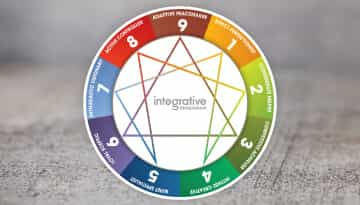
The Enneagram is a model of nine personality types, each organised around a core motivation, that offers deep insight into the motivations that drive how we think, feel and act, and into how we relate to others.
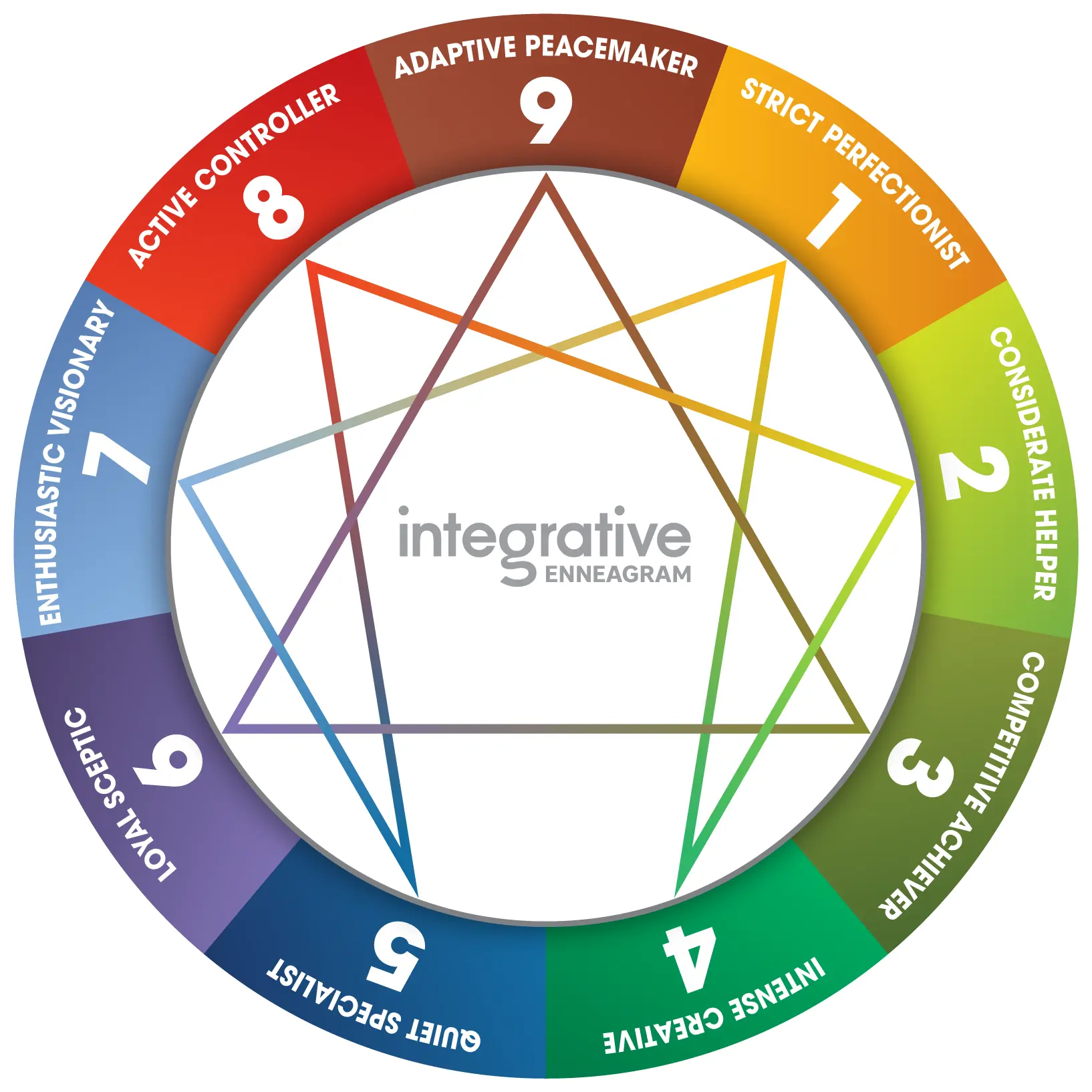
The Integrative Enneagram unlocks and supports your journey of self-discovery and uncovers the patterns of behaviour that subconsciously drive and motivate us to behave in certain ways. When we make these motivations conscious, we are able to transcend them and develop richer, more supportive ways of being. Working with this model empowers individuals to take the first step of responsibility for their own behaviours and growth, through a greater understanding of why they act and react the way they do.
The Enneagram is an archetypal framework consisting of nine Types that offer in-depth insight to individuals, groups, and collectives. Consisting of 3 Centers of Intelligence, 9 Enneagram Types, Wings, 27 Subtypes, and more, this model offers a rich map to personal development. It does not box people in but rather opens a pathway to self-discovery and greater personal awareness.
As a framework, it speaks to the journey of integration in a profound way. It is able to uncover the uniqueness of each individual and his or her journey. It does not only reveal what holds an individual back, you can also gain valuable insights into your journey towards strength and liberation, connecting us to our strengths and higher selves.
The Enneagram is, therefore, a sense-making tool or a framework that enables the development of self-knowledge and meta-awareness.
The iEQ9, developed by Integrative Enneagram Solutions, is a questionnaire that identifies your Enneagram profile within this framework. A 2026 study examined it in 63,944 people across five languages; read the iEQ9 research.

The Enneagram is a model of human psychology and personality theory, that is based on the idea that each person has a unique and innate personality structure, or "essence," that shapes the way they see the world and themselves.
The word "Enneagram" comes from the Greek words "ennea" meaning "nine" and "gramma" meaning "something written" or "a figure". The Enneagram symbol is composed of a circle with nine equidistant points, each representing one of the nine personality types. The symbol is old, but the personality model used today was developed in the twentieth century, notably by Dr Claudio Naranjo.
These Types are characterized by a unique combination of strengths, weaknesses, unconscious motivations, fears, and triggers that shape their thoughts, feelings, and actions. The Enneagram is not only a tool for understanding ourselves and others, but is also a powerful tool for growth, self-awareness, self-discovery, and spiritual growth. It can help individuals understand their own motivations and behaviours, as well as the motivations and behaviours of others, which can lead to more harmonious relationships, better communication, and more effective problem-solving.
The Enneagram can be used to help us better understand our own personalities and the personalities of others, as well as to develop more self-insight and self-acceptance.
Here are short definitions of the 9 personality Types. Follow the links to read more on each Type. For a fuller picture, use a questionnaire that has been researched and published, such as the iEQ9. To discover your Enneagram type, take the iEQ9 and get a 23-page Personal report or a 42-page Professional report that provides valuable support on your path to knowing who you really are and how to truly become a new you.



We all have three basic instinctual drives that are essential to the human experience – all three reside in us as necessary, body-based, primal forces. They are separate from personality and are behind our life strategies, which, though often unconscious, powerfully direct our fundamental way of being.
While all three these Instincts are always there, one of the three becomes dominant and is more easily accessed and, therefore, more easily used than the others. When the dominant Instinct merges with the Core Type and basic fear, a new character structure is formed. These are the 27 Subtypes according to Claudio Naranjo's model.
The iEQ9 Enneagram Test is designed to clearly identify your dominant Instinct and describe your Subtype within Dr Claudio Naranjo's 27-subtype model.
Read more about the 27 Subtypes
Gurdjieff, in his Fourth Way teachings, explained that we function with three ‘brains’ that influence the way we think, feel, and behave. These are Thinking (head-centred), Feeling (heart-centred) and Action (body- or hands-centred). Normally, one of these Centers is dominant, and we have to consciously develop the use of the other two. For example, someone might say that they think their feelings, or act before thinking, or that their feelings often prevent them from thinking
There is a powerful connection between the Enneagram system and the Centers, so much so that the Nine Types can be grouped into three triads, each of which has its own set of issues that underlie our behaviour. For example, the head-centred Enneagram Types (E5, E6 and E7) have issues with fear and cynicism; heart-centred Enneagram Types (E2, E3 and E4) have issues with image, sadness and shame; and the body-centred Enneagram Types (E8, E9 and E1) have issues with control and anger.
The iEQ9 test has a built-in assessment for the Centers and gives practical coaching tips to bring them into balance.
Read more about the Centers
The Wings refer to the two Enneagram types adjacent to your Core Type on the circle. These ‘close neighbours’ influence you but do not change your Type. If the Core Type is like ice-cream in a bowl, the Wings are the kind of sauce you add to it. It is not a second type of ice-cream, just the flavours of the adjacent Types. We all have access to both of our Wings, and each has a different set of resources and characteristics that we find helpful at times. Sometimes, one of these Wings is more familiar, or dominant. Some people don't like to add much ‘sauce’ at all (true Type or light Wings), others add a lot (strong Wing/s), and some add both (balanced double Wings).
The Wings enable us to understand the Types not only in isolation, but in relationship to one another. Since the Enneagram Types are seen as a spectrum or continuum, connecting to your Wings can help you understand the subtleties of your resonating Type. By leaning into our Wings, to one side or the other, we expand our perspective and increase our emotional and behavioural repertoire. The Wings may also offer a way to understand the tension and influences we experience when we are stuck, and create the potential we can access to reframe a dilemma as a transformation opportunity. Your iEQ9 report describes the influence of both neighbouring types and how you can draw on each of them for growth.
Read more about the Wings
The lines follow two sequences, 3-6-9 and 1-4-2-8-5-7-1. The Line symbolises movement, change dynamics and strong polarities. These lines indicate the influences and interactions between Types, patterns of energy movement or flow. While our Core Type remains constant as a 'home base', we are also capable of travelling, or even being pulled, along these connecting lines. Each Type or number is related to those on the other end of the line, as a polarity or paradox to be lived into.
Moving along the lines offers a significant shift in perspective or point of view, which allows us to step out of our typical style and reactions and create new ways to respond to the world around us. The lines, therefore, offer rich potential for exploration and evolution as they offer balance and fresh resources to our Core Type. Ideally, we work to develop the ability to be fluent in the lines as a continuum, as a path of movement for our integrated self.
Read more about the Lines
The levels refer to the degree of self-mastery we have achieved so far in our integration journeys in life. This is a time-bound measure and changes as we grow and develop, or as our circumstances become more or less challenging. While integration is not fixed, and people may move between high and low integration behaviours depending on context, most people show a concentration of energy and behaviour at a particular Level of Integration over time.
Read more about the LevelsThe iEQ9 (Integrative Enneagram Questionnaire) is a dynamically adaptive intelligent assessment with 175 questions. It will take you about 30 minutes to complete and it will score and describe: your Enneagram Profile, 27 Subtypes, Centers, the influence of both Wings, Lines, Levels of Integration and 6 dimensions of stress and Strain.
Take the iEQ9 in about 30 minutes and receive your personal report.
Buy the iEQ9 Enneagram TestThe iEQ9 is built on Dr Claudio Naranjo's 27-subtype model and has been researched and refined since its launch in 2011. Our psychometry experts and data scientists have been refining the assessment since its launch in 2011, to an accuracy of more than 95%. A 2026 study of 63,944 people in five languages found scale reliability (ordinal alpha) of .74 to .87, and the iEQ9 was independently certified twice by external psychometricians, in 2018 and 2019. It is also user-friendly and accessible to everyone.
There is no single official Enneagram test. There are many free Enneagram tests on the internet, but few publish any research on how they perform. The iEQ9 has been researched and refined since its launch in 2011, most recently in a 2026 study of 63,944 people in five languages. The founder of Integrative has worked directly with Claudio Naranjo to adapt the core teachings directly from his expertise. The iEQ9 is used by 6,000+ accredited practitioners with their clients on a daily basis.
People tell us that they find the iEQ9 questionnaire easy to use even though it is comprehensive, integrated, dynamic and adaptive. The test has 175 questions, which are intelligently pulled out of more than 2,000, and takes about 30 minutes to complete. It covers in one report what would otherwise take several separate assessments. The research behind it continues as new data comes in. You can trust that we developed the expertise, with the guidance of solid theory, to give you a world-class soul map.
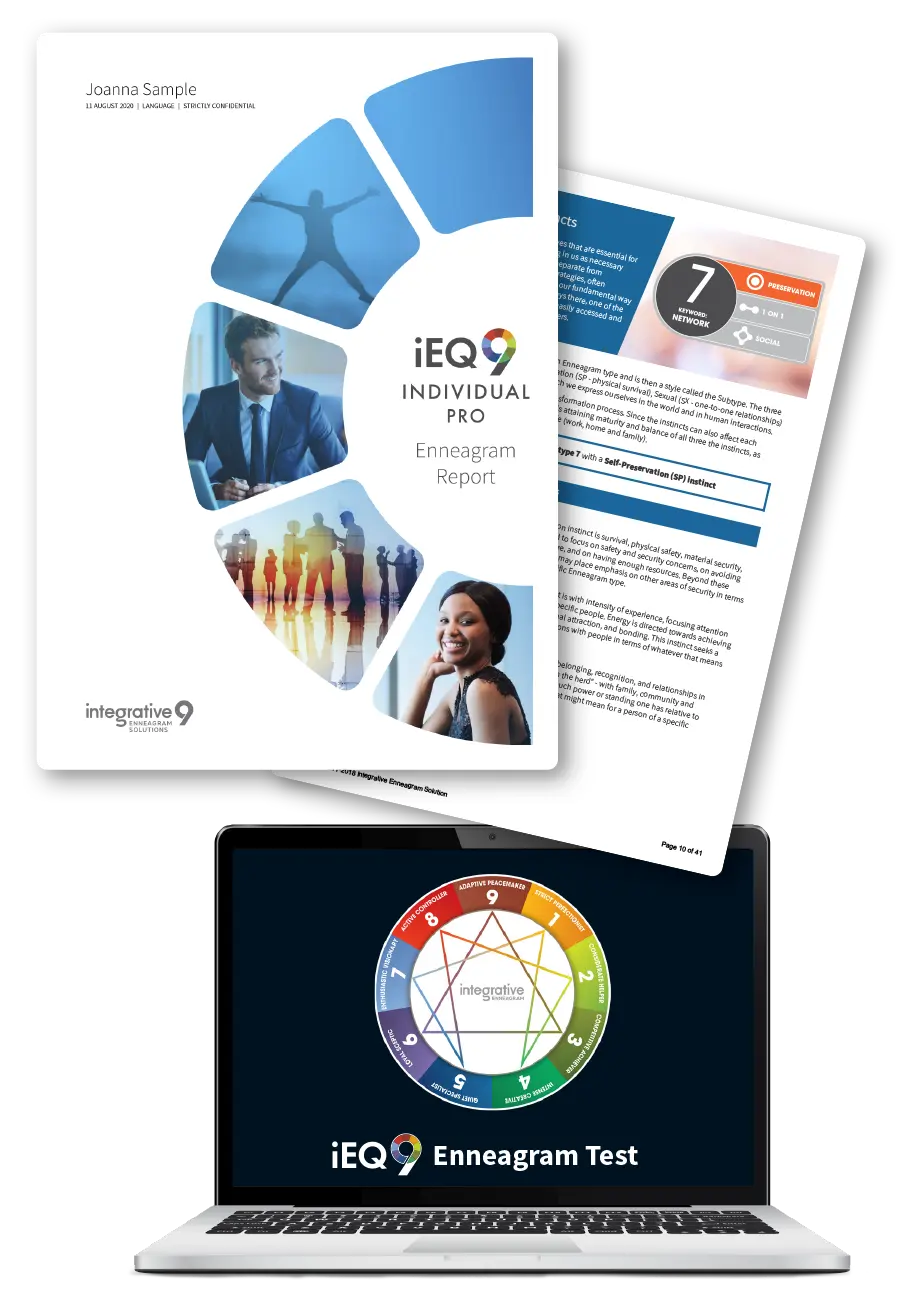
Over the past decades, the Enneagram has become widely used in coaching and people transformation and coaching environment. The use of the Enneagram not only fast-tracks insightful discovery, growth and integration, but also gives durability and magnitude to the evolution process over time.

Some of the key advantages of using the Enneagram is that it helps to create meta-awareness at the level of motivation. This means that it can help individuals to understand the underlying reasons for their actions and behaviours, which can, in turn, lead to increased consciousness and confidence.
Another benefit of using it is that it enables individuals to clear core emotional issues. By understanding the motivations behind their actions, individuals can work through unresolved emotional issues that may be holding them back.
The Enneagram also provides a framework for understanding functional and dysfunctional behaviours that stem from core motivations. This can help individuals to identify behaviours and blind spots that are not serving them and guide them in developing healthier ways of thinking and acting

One of the most important benefits is that it leads to a greater understanding of and deeper compassion for self and others. By understanding the motivations of others, we can develop more empathy and better understand their actions.
The Enneagram also uncovers pathways to development and integration. Additionally, it can increase productivity and motivation by helping individuals to understand their unique strengths and weaknesses and to set goals that align with their core motivations. Finally, the Enneagram creates a language and sense-making framework that stretches deeper than a personality trait-based approach and builds leadership authenticity, potency and impact.
Read more for Individuals
The Enneagram is a valuable tool for professionals and leaders as it can help to reduce judgement and criticism of others while building understanding and tolerance. By providing a framework for understanding the motivations of each member, the Enneagram can help leaders to see past superficial differences and to appreciate the unique strengths and contributions of each member.
Additionally, the Enneagram provides a framework for making sense of conflict and challenges. Rather than blaming strife on 'personality differences', the Enneagram allows members to identify underlying motivations that may be contributing to the conflict. This can lead to more effective, resilient and lasting solutions.
It also enables teams to move beyond traditional 'fault lines' and repolarise. This can lead to improved working relationships and increased productivity.

Furthermore, the iEQ9 can support teams by giving a deeper understanding of how group members relate to one another, leading to improved communication and a new language framework for team dynamics. In a nutshell, the Enneagram can be a powerful tool to improve team dynamics, communication, and ultimately, productivity in the workplace.
The iEQ9 Team Full Report can be used by coaches with leaders to significantly enhance their resilience. It uses a unique fractal mathematical algorithm to generate a group gestalt.
Read more for Professionals
The Enneagram gives organisations a shared language for motivation, which supports culture and staff wellbeing. It changes the way teams work together by providing an insightful lens into the motivations and goals of each member. This understanding can help mitigate workplace politics and foster collaboration, leading to decreased conflict and improved team dynamics
The Enneagram acts as a game-changer for change management, empowering individuals to embrace and adapt to organizational transformations with greater ease. The deeper comprehension of team member's motivations and patterns equips organizations to tackle change with confidence, thereby decreasing fear and anxiety.

Organizations can tap into the full potential of their workforce by comprehending the unique strengths and contributions of each member. This integration leads to a creative and productive work environment, driving performance and boosting overall productivity.
The Enneagram test also serves as a valuable tool for project management and leadership, providing a framework for effective organization and execution of projects. This leads to greater integrity within the organization, improving communication and enabling the discovery of hidden talents.
Culture change and effective communication are crucial elements of a positive and productive work environment. The Enneagram plays a significant role in promoting both, thereby contributing to employee happiness and overall wellbeing. This framework also enables organizations to develop more impactful talent and training programs, elevating individual growth and development. The iEQ9 is for coaching and development — never for hiring, selection or performance decisions.
Read more for Organisations
The iEQ9 Enneagram Test works at the level of motivation: it explains why you do what you do, not only what you do. It identifies your core type and which of the 27 subtypes you are, shows how you express thinking, feeling and action, and maps your lines of tension and release and your current level of integration. The questionnaire is dynamically adaptive, with 175 questions selected from more than 2,000, and its nine type scales are supported by published research on 63,944 people in five languages. The result is a path for development, not just a description. Rooted in psychological and spiritual teachings, it gives a profoundly meaningful perspective for anyone serious about growth.

The Myers-Briggs Type Indicator sorts people into 16 types from four pairs of preferences, such as extraversion or introversion and thinking or feeling. It is widely used and gives people an easy shared vocabulary. It describes preferences, though, not the motivation behind them: two people with the same four letters can act from very different drives, which is exactly what the Enneagram separates. The MBTI has no built-in model of how a person develops over time, and it says little about blind spots, defences and habits.
The Strengths Finder ranks a person’s talents across 34 strengths, which can help with career and leadership conversations. By design it looks only at strengths. It does not address weaknesses or blind spots, and it does not explain the motivation that turns a strength into an overused habit. It has no model of how strengths interact or change across situations and relationships. The Enneagram treats an overused strength and its cost as parts of one pattern, which is where development starts.
The Big Five is the most widely researched trait model. It measures how much of five broad traits a person has: Openness, Conscientiousness, Extraversion, Agreeableness and Neuroticism. It tells you how much, but not why, and it has no model of how a person grows. In our own comparison study of 2,699 people, the iEQ9 type scales overlapped with the Big Five where theory expects, without repeating it: the Big Five explained 27% of each type scale on average.

The nine-type model is more useful for work with blind spots, personal insight, counselling or therapy, and in the workplace.
The Enneagram gives a deeper and more complete understanding of your whole personality and of why you do what you do. The iEQ9 turns that understanding into a report you can act on.

Discovering your Enneagram Type can be a transformative experience, allowing for a deeper understanding of yourself and your interactions with the world. By revealing your strengths, weaknesses, and unconscious motivations, the nine Types model can pave the way for greater self-awareness and acceptance.
Determining your personality Type is a process that can involve multiple approaches. Some may choose to take a test, work with a seasoned practitioner, or simply study the Core Types to see which resonates with them most. The iEQ9 offers a researched starting point, which you can then explore further with an accredited practitioner.
Once you have a clearer grasp of your Type, it's just as crucial to acknowledge your blind spots - the areas where you're most prone to struggle. For instance, a Type 8 may have difficulty expressing vulnerability, while a Type 4 may battle with self-doubt. By recognizing these blind spots, you can work to overcome them and grow as a person.

The impact of understanding your Type extends far beyond self-discovery, affecting your personal wellbeing and professional life in profound ways. By clarifying your strengths and weaknesses, you can improve communication, problem-solving, and relationships, leading to greater success in your career. Moreover, an understanding of your Type can reveal the best ways to care for yourself emotionally, physically, and spiritually.
The test and model provide a framework for understanding your personality and behaviour, serving as a valuable tool for growth and awareness. By gaining a deeper understanding of what motivates your thoughts, emotions, and behaviours, you can cultivate greater self-acceptance and a holistic understanding of yourself. Furthermore, by recognizing areas for growth, it offers a roadmap to reaching your full potential, propelling you towards a life of self-discovery and growth.

The Enneagram test or assessment can be applied in various settings such as in leadership resilience building, or discovering and unlocking team dynamics. For example, knowing the personality Types of each member can be beneficial for effective communication and collaboration. In leadership transformation, it can be used to zoom in on and develop strengths and to address blind spots. In conflict resolution, it can be used to understand the motivations and perspectives of the different parties involved.
The Enneagram describes personality through motivation rather than traits alone, and the iEQ9 is a researched questionnaire for working with it. The Enneagram can be a valuable tool for evolving and maturing, by providing a framework for understanding one's personality and behaviour. It can be applied in various settings such as in coaching, mentoring, leadership transformation, and the enhancement of teams. It can also be used to reveal one's main challenges and how to face them. By understanding one's Type, one can find the areas of struggle, and develop guidelines for addressing those challenges.
Take the iEQ9 to identify your Type, subtype and growth path, or select a Type below to read more.
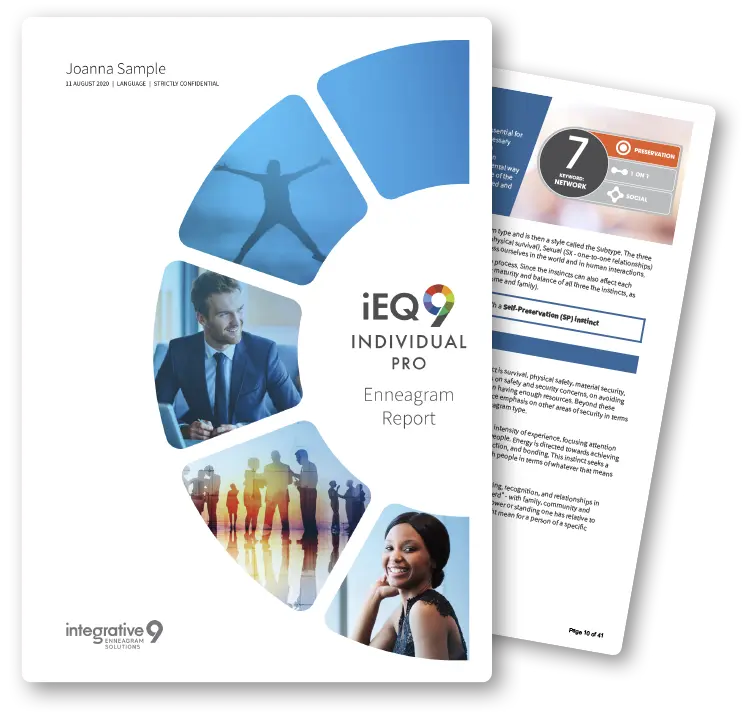
See your type, subtype and growth path in a personalised report. The iEQ9 is an intelligent, dynamically adaptive questionnaire: the questions change based on your answers, so each person answers 175 questions drawn from more than 2,000. It takes about 30 minutes, and your report covers your Enneagram profile, your subtype (one of 27), the Centers, the influence of both neighbouring wing types, Lines, Levels of Integration and six dimensions of Strain. Validated on 63,944 people across five languages. Reports from USD 60. Full refund within 30 days if you haven't opened your assessment link.
Get Your Enneagram Test
 What is the Enneagram?
 Introduction to the 27 Subtypes
 Introduction to the 3 Centers
 Wings
 Lines and Integration
 Enneagram History & Origin
 Enneagram for Myself
 Enneagram for Practitioners
 Enneagram for Business
 iEQ9 Individual Reports
 iEQ9 Team Reports
 iEQ9 Questionnaire
 Training Events
 Level 1 iEQ9 Accreditation
 Level 2 Enneagram Team Dynamics
 International Enneagram Conference
 iEQ9 Community of Practice Events
 About Integrative9
 Meet the Faculty
 Testimonials
 Contact Us