


 One of the three subtypes of Type 9: The Adaptive Peacemaker
SO9 is the Social subtype of Enneagram Type 9, the Adaptive Peacemaker, and the countertype of Type 9. Its key name is Participation.
The shorthand joins an instinct to a type: "SO" is the Social instinct and "9" is Enneagram Type 9. You will also see it written as "Social 9" or "SO 9". It is one of the 27 subtypes in Dr Claudio Naranjo's model, which the iEQ9 uses.
This page describes that model. Read it as a prompt for reflection, not as a rule about any one person.
Nines want to be settled and in harmony with the world, and they are good at finding common ground. The Social instinct turns attention to belonging, the group and a shared purpose. In the SO Nine the two combine: peace is found by belonging to a group and working on its behalf.
SO Nines are friendly and engaged, often as mediator or facilitator. They put their own issues aside, keep a cheerful front so as not to burden others, and make sacrifices to meet the group's needs. Their effort can tip into overwork, with strain they have not mentioned. The cost appears when the person can explain every position in the room except their own.
The key name, Participation, is shorthand for belonging through taking part. It is not a summary of the whole person.
In this model the passion of Type 9 is called Self-Forgetting. It does not mean laziness; it means losing touch with one's own priorities, opinions and wants. In the SO Nine it is easy to miss because the person is so busy: what gets forgotten is their own preference within the activity. The quality the model calls Essential Action, which this site also describes as right, sustainable action, is not simply doing more, since busyness can be another way of staying out of touch. It means action with the person in it: acting from one's own wants and priorities.
In each type, one subtype behaves in a way that runs against the usual picture of the type. The motivation is the same; the expression differs. Nines are usually described as easy-going and slow to act. The SO Nine is often busy and hard-working for the group, so an SO Nine may not recognise themselves in descriptions of Type 9 as relaxed or inactive.
A team is choosing between two suppliers. One member sums up everyone's view fairly and offers to draft the comparison. Asked which supplier they would choose, they say either would be fine.
One reading is the SO9 pattern: full participation that leaves the person's own view out. Another is that they genuinely have no preference, or that in this team a junior person stating a view carries a real cost.
The useful move is to state a preference before summarising the group.
All three subtypes share the Nine's wish to feel connected and keep the peace. They differ in where that drive is aimed.
The subtypes overlap. Many Nines will recognise something in all three descriptions.
SO Nines can be mistaken for Type 3, the Competitive Achiever, because of their output, or for Type 2, the Considerate Helper, because of their helpfulness. The useful question is what the effort protects: for the SO Nine it tends to be belonging and harmony rather than recognition or appreciation. Treat this as a question, not a rule.
Equally, helpfulness or hard work is not evidence of SO9; a demanding job or a culture that prizes involvement produce the same behaviour in any type. And if an SO Nine's contributions are overlooked, the group's habits may be as much the reason as the person's style.
In your next group discussion, say what you think in one or two sentences before you summarise what others think. Afterwards, notice how the group responded, and how it felt to have your own view on the table.
This is an experiment to learn from, not a test of whether you are an SO9. Bringing balance to all three instincts is part of subtype work, and the instinct you use least is a useful place to begin. More on the core type is on the Type 9 Adaptive Peacemaker page.
Reading the descriptions is a good place to start, though subtypes overlap and no description settles it on its own. The iEQ9 reports your subtype alongside your core type. Take the iEQ9 individual assessment, browse all 27 Enneagram subtypes, or read the guide to types and subtypes that get confused. Published research covers the nine core type scales, and research at subtype level is planned.
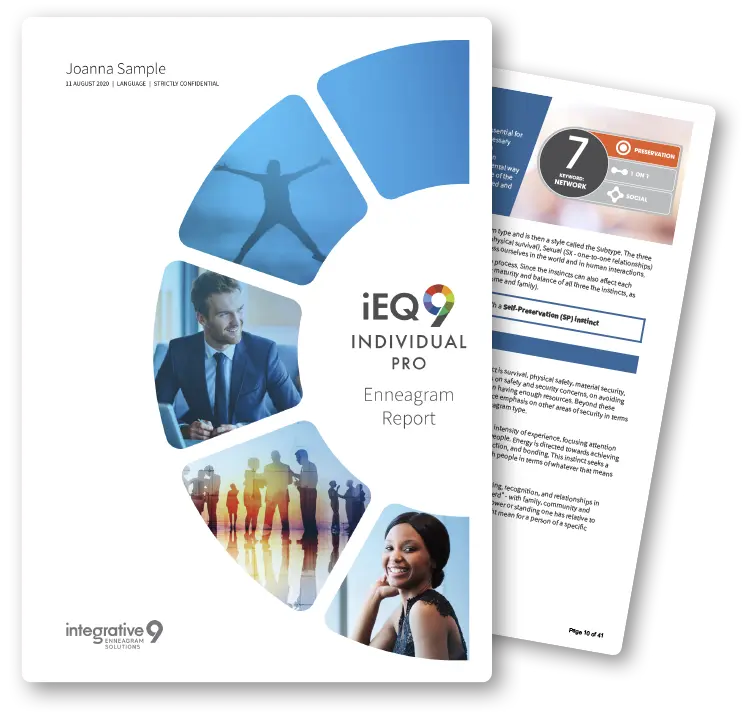
See your type, subtype and growth path in a personalised report. The iEQ9 is an intelligent, dynamically adaptive questionnaire: the questions change based on your answers, so each person answers 175 questions drawn from more than 2,000. It takes about 30 minutes, and your report covers your Enneagram profile, your subtype (one of 27), the Centers, the influence of both neighbouring wing types, Lines, Levels of Integration and six dimensions of Strain. Validated on 63,944 people across five languages. Reports from USD 60. Full refund within 30 days if you haven't opened your assessment link.
Get Your Enneagram Test

 What is the Enneagram?
 Introduction to the 27 Subtypes
 Introduction to the 3 Centers
 Wings
 Lines and Integration
 Enneagram History & Origin
 Enneagram for Myself
 Enneagram for Practitioners
 Enneagram for Business
 iEQ9 Individual Reports
 iEQ9 Team Reports
 iEQ9 Questionnaire
 Training Events
 Level 1 iEQ9 Accreditation
 Level 2 Enneagram Team Dynamics
 International Enneagram Conference
 iEQ9 Community of Practice Events
 About Integrative9
 Meet the Faculty
 Testimonials
 Contact Us
