


 One of the three subtypes of Type 1: The Strict Perfectionist
SO1 is the Social subtype of Enneagram Type 1, the Strict Perfectionist. Its key name is Non-adaptable.
The shorthand joins an instinct to a type: "SO" is the Social instinct and "1" is Enneagram Type 1. You will also see it written as "Social 1" or "SO 1". It is one of the 27 subtypes in Dr Claudio Naranjo's model, which the iEQ9 uses.
This page describes that model. Read it as a prompt for reflection, not as a rule about any one person.
Ones are driven by the need to be good and right, and they want to lead by example. The Social instinct is the drive to get along with others and form secure social bonds, with a high awareness of norms and status in groups. In the SO One the two combine: the drive to be right is turned towards conduct in the group and the example being set.
SO Ones set an example of integrity and principled conduct, and strict self-control can set them apart from those around them. They are motivated by fairness and by "making things right". At their best they think in systems and live out their values rather than only talking about them.
The key name, Non-adaptable, is shorthand for holding to one's own standards rather than adjusting to the group's. The risk is that a preferred method becomes as fixed as the principle it was meant to serve. The name describes a pattern, not an identity.
In this model the passion of Type 1 is called anger. The word does not mean that Ones are angry people. It describes a steady resentment that things, including oneself, are not as they should be. In the SO One it is usually well controlled and may come across as coolness or correctness rather than heat.
In a shared office kitchen, one person always washes up straight away and has put a note above the dishwasher explaining the right way to load it. Colleagues joke about the note, and some feel judged by it.
The person may have been asked to look after the kitchen, or may be reacting to a week of other people's mess. In the SO1 pattern, something else is going on as well: showing the right way to do things is how they contribute to a group, and a standard that others ignore can feel like a standard under threat. The note alone does not say which.
The useful move is to separate the principle (a kitchen everyone can use) from the method (this way of loading the dishwasher), and to ask which of the two the group has actually agreed to.
All three subtypes share the One's drive to be good and right, and the same passion, anger. They differ in where that drive is aimed.
The subtypes overlap. Many Ones will recognise something in all three descriptions.
The SO One is often taken for rigid or self-righteous. Formality or a firm view in a meeting are not evidence of SO1: they may come from a role such as compliance or audit, or from a culture that values reserve. Nor does the Social instinct imply superior morals. It describes where attention goes, and people of every type have it.
Equally, holding firm is not a flaw. Groups need someone who will name the standard when it is inconvenient. Read the pattern as a tension between serving a principle and holding on to one's own way of serving it.
Next time you find yourself resisting a proposed change, write down in one sentence the principle you want to protect. Say it to the group, then ask for two different ways of meeting it, including one you would not have chosen. Afterwards, reflect on whether the principle survived and what was harder to let go of than you expected.
This is an experiment to learn from, not a test of whether you are an SO1. Bringing balance to all three instincts is part of subtype work, and the instinct you use least is a useful place to begin. More on the core type is on the Type 1 Strict Perfectionist page.
Reading the descriptions is a good place to start, though subtypes overlap and no description settles it on its own. The iEQ9 reports your subtype alongside your core type. Take the iEQ9 individual assessment, browse all 27 Enneagram subtypes, or read the guide to types and subtypes that get confused. Published research covers the nine core type scales, and research at subtype level is planned.
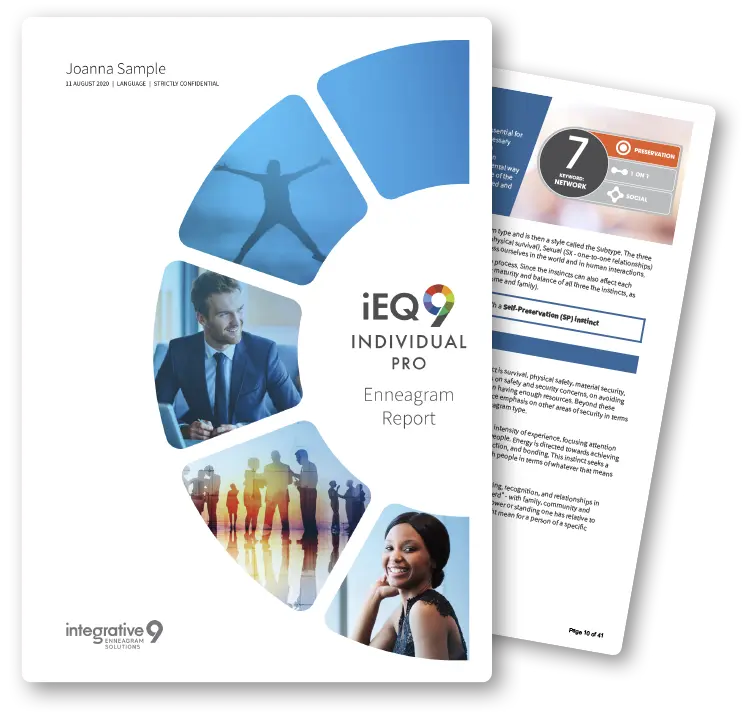
See your type, subtype and growth path in a personalised report. The iEQ9 is an intelligent, dynamically adaptive questionnaire: the questions change based on your answers, so each person answers 175 questions drawn from more than 2,000. It takes about 30 minutes, and your report covers your Enneagram profile, your subtype (one of 27), the Centers, the influence of both neighbouring wing types, Lines, Levels of Integration and six dimensions of Strain. Validated on 63,944 people across five languages. Reports from USD 60. Full refund within 30 days if you haven't opened your assessment link.
Get Your Enneagram Test

 What is the Enneagram?
 Introduction to the 27 Subtypes
 Introduction to the 3 Centers
 Wings
 Lines and Integration
 Enneagram History & Origin
 Enneagram for Myself
 Enneagram for Practitioners
 Enneagram for Business
 iEQ9 Individual Reports
 iEQ9 Team Reports
 iEQ9 Questionnaire
 Training Events
 Level 1 iEQ9 Accreditation
 Level 2 Enneagram Team Dynamics
 International Enneagram Conference
 iEQ9 Community of Practice Events
 About Integrative9
 Meet the Faculty
 Testimonials
 Contact Us
