What is the Enneagram?
 Introduction to the 27 Subtypes
 Introduction to the 3 Centers
 Wings
 Lines and Integration
 Enneagram History & Origin
 Type 8 - The Active Controller
 Type 2 - The Considerate Helper
 Type 5 - The Quiet Specialist
 Type 9 - The Adaptive Peacemaker
 Type 3 - The Competitive Achiever
 Type 6 - The Loyal Sceptic
 Type 1 - The Strict Perfectionist
 Type 4 - The Intense Creative
 Type 7 - The Enthusiastic Visionary
 Enneagram for Myself
 Enneagram for Practitioners
 Enneagram for Business
 iEQ9 Individual Reports
 iEQ9 Team Reports
 iEQ9 Questionnaire
 Training Events
 Level 1 iEQ9 Accreditation
 Level 2 Enneagram Team Dynamics
 International Enneagram Conference
 iEQ9 Community of Practice Events
 About Integrative9
 Meet the Faculty
 Testimonials
 Contact Us

At the end of a good debrief, an executive will often ask the coach to say what to do differently on Monday. This article offers a way to answer: meet the practical need, and hand back the part of the work that only the client can do, as an experiment the client designs.
The problem: the request at the end of a good debrief
The debrief has gone well. The executive agrees with most of the report and has quoted a line from it back to you with a small laugh of recognition. Then, with ten minutes left, they close the folder and say:
"This is spot on. So just tell me what to do differently on Monday."
Many of us have answered this the obvious way: we turn the report's development areas into a tidy list of actions. The next session opens with a polite update: the list was useful, things have been busy, and very little has changed. (The executive in this article is a composite of many such sessions, not one client.)
The request is reasonable: executives are paid to turn insight into action. But it carries a hidden diagnosis. It treats what the report has shown as a problem with a known answer that an expert can hand over. Often that holds for only some of what the debrief has shown.
The technique in brief
When the executive asks to be told what to do on Monday:
- Accept the practical need out loud, and help with the technical part.
- Name what you notice: part of this may be something no outside expert can fix.
- Hand the design over: if next week were an experiment rather than a plan, what would the client try, and what would they watch for?
- Bring resistance into the room: what will make this hard to keep doing when the pressure is back?
Let the client write the experiment down, and at the next session ask what was learned before asking whether it was done.
Two kinds of problem
In The Practice of Adaptive Leadership, Ronald Heifetz, Alexander Grashow and Marty Linsky separate technical problems from adaptive challenges. Between the two sits a mixed category.
| Kind of problem | What is clear | Who does the work |
|---|---|---|
| Technical problem | Both the problem and the solution are clear. | An authority with the right expertise can do the work. |
| Mixed | Part of the problem is clear, part of it requires learning. | The work is shared between the authority and the people involved. |
| Adaptive challenge | Neither: the people who have the problem must learn their way to a definition and a solution. | The work is theirs. |
The authors give signs that a challenge is mainly adaptive, among them:
- A persistent gap between aspirations and reality.
- A current repertoire that is not enough.
- A problem that comes back after a short-term fix.
- A persistent dependence on authority: people keep looking to someone outside them for the answer.
They also list remarks that suggest an adaptive challenge has been read as technical. One is "This will be an easy fix", and the question they offer in reply is, in effect, whether this might be a problem a consultant cannot fix.
Heifetz, Grashow and Linsky write about organisations and systems; applying their distinction to one leader's type pattern is our step, not theirs. On our reading, a type pattern fits their description closely. The gap between what the leader hopes for and what keeps happening has usually lasted years, and the leader's current repertoire is the pattern itself, so more of it will not close the gap. And "just tell me what to do" puts the coach in the role of the outside authority who holds the answer.
When the request is part of the pattern
Take one client, an executive whose core type is Competitive Achiever. In the Integrative Enneagram model, Threes are practical and task-oriented, and their idealised self-image includes being efficient and efficacious. Their worldview, as the Learning Center describes it, turns on avoiding failure. For this client, a plan is what has always worked. Hand over a list and it will be carried out, probably well, and reported on with some polish.
Suppose the development work from the debrief is something a list cannot reach: letting colleagues see a project that is struggling before it has been rescued, or noticing the moment when working to look successful takes over from the work.
A coach's action plan then gives the pattern one more task to perform. The client can complete every item and stay exactly where they started. The Integrative Enneagram description notes that Threes adapt their persona to what success requires in a setting, and in a coaching room success can look like being a very good coachee.
Not every Competitive Achiever asks for the list, and executives of every type do. In Integrative Enneagram terms the request may be the core type showing up inside the coaching relationship, which makes it useful data. A strong pull to write the list yourself is data too. “Your Type Comes to the Debrief Too” (for accredited practitioners) looks at how the coach's own type comes into the debrief.
Holding both needs
None of this is an argument for refusing to be practical. An executive who leaves with nothing to do on Monday has reason to doubt the coaching. Here the mixed category (part technical, part adaptive) helps: much of what a debrief shows has a technical part the coach can help with and an adaptive part only the client can do.
Goal research, as Anthony Grant applies it to coaching, supports the practical half more strongly than some of us admit. Writing on reflection in coaching, Grant links the action steps set at the end of a session to what researchers call implementation intentions: plans that say what will be done, where and how. Grant points to a considerable body of research suggesting that setting such intentions, and writing them down, improves goal attainment. The standard reference is Gollwitzer and Sheeran's 2006 meta-analysis; a 2024 update with corrections for publication bias puts the effect lower but still positive.
Grant accepts that the coach sometimes needs to be directive when the steps are set, but insists that the coachee, not the coach, writes the steps, because their power comes from the meaning given to them in the conversation. On our reading, the research does not tell us to withhold plans. It tells us that a plan works best when it carries the client's own meaning, which is what a coach-written list for adaptive work lacks.
The Gleicher-Dannemiller change equation, which we teach in the Learning Center, makes a related point. Change becomes likely when dissatisfaction (D), vision (V) and first steps (F) together are greater than resistance (R): D x V x F > R.
A plan is one of the terms, so wanting one is legitimate, but if dissatisfaction is low, a better plan will not outweigh resistance. The Learning Center notes that real dissatisfaction usually shows in the client's reason for coaching and in elevated strain in at least one area of the strain profile. We find that an executive who asks for a fix while the strain profile is quiet, and whose reason for coaching is vague ("the company offers it"), is more often missing D than F.
For the adaptive part, Heifetz and his colleagues describe giving the work back while controlling the temperature, keeping people in what they call the productive zone of disequilibrium: uncomfortable enough to keep working, not so uncomfortable that they disengage. In a session that means you still offer what you know, and disappoint one expectation only: that the coach will design what happens next.
Try this: an experiment the client designs
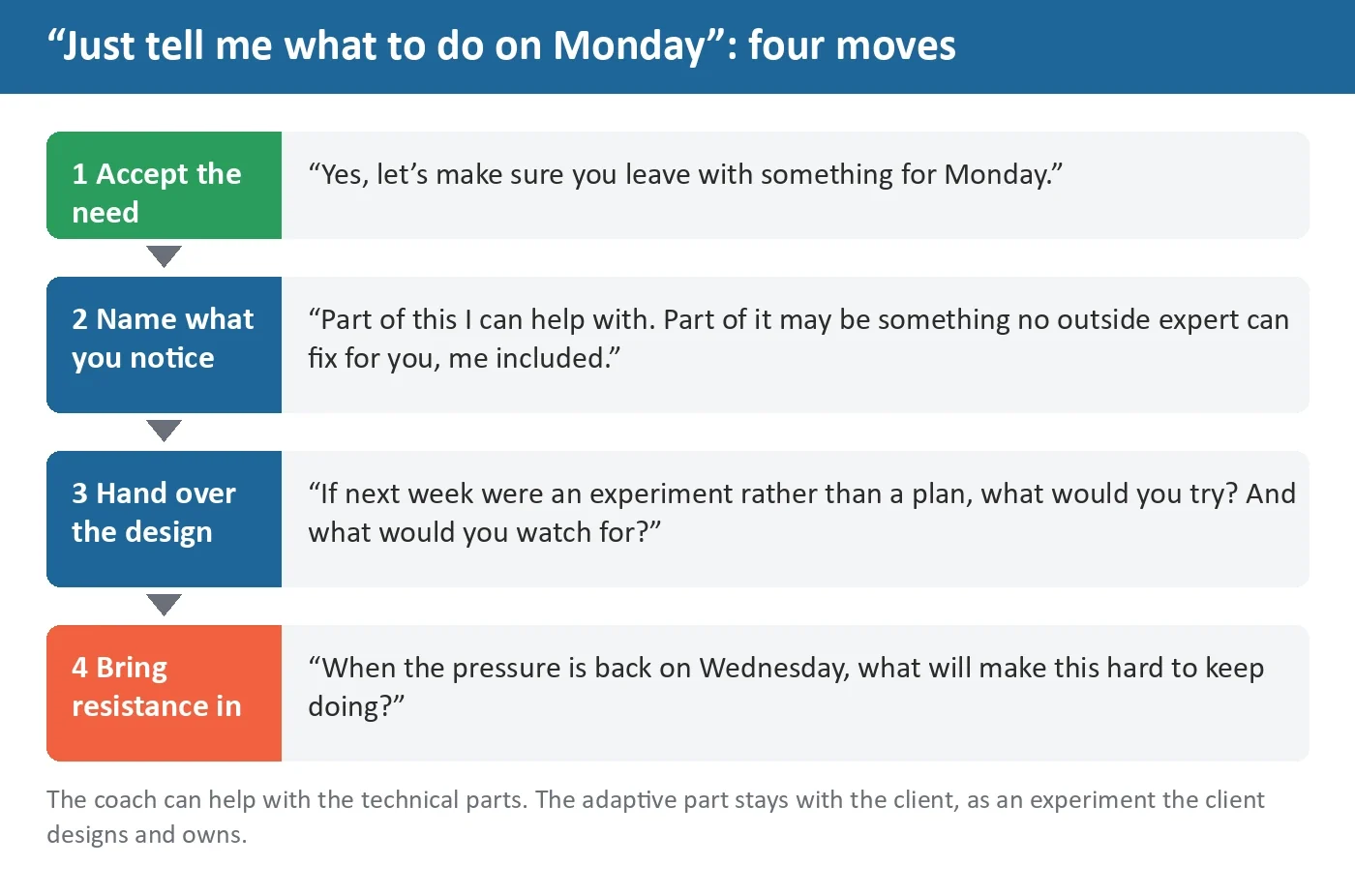
Heifetz and his colleagues suggest treating everything in adaptive change as an experiment, an educated guess rather than a fixed commitment. That suits executives: an experiment is still practical, and it belongs to whoever runs it.
Before the session
- The request usually arrives near the end, so plan the debrief to finish its content with at least fifteen minutes to spare.
- Before you meet, read the Coaching Companion for signs of dissatisfaction (D): the strain profile, and the client's stated reason for coaching.
- Decide in advance which development areas are technical. How to run a good one-to-one is technical, and you can help with it. Why the client keeps cancelling them is probably not.
The four moves
1. Accept the practical need. Say it out loud:
"Yes, let's make sure you leave with something for Monday."
2. Name what you notice. Keep it brief:
"Part of this I can help with. Part of it, I think, may be something no outside expert can fix for you, me included."
3. Hand the design over.
"If next week were an experiment rather than a plan, what would you try? And what would you watch for, to know whether it taught you anything?"
4. Bring resistance into the room, before it turns up mid-week:
"When the pressure is back on Wednesday, what will make this hard to keep doing?"
Let the client write the experiment down, in their own words. Your contribution can still be technical where it helps. After you hand the design over, allow the silence. It is often the first moment in the session when the client is doing work the coach cannot do for them.
When the first answer is a task
"I'll block thirty minutes a week for one-to-ones" is a fair start: it is a first step (F) in the change equation. You can widen it without taking it over:
"And what will you have to let go of to protect that time when a deadline hits?"
At the next session, ask "What did you learn?" before "Did you do it?" The first keeps attention on learning; the second invites a task-oriented client to report on completion.
What goes wrong, and what to do then
The client pushes back
Some executives hear the second move (saying that part of this may be something no outside expert can fix) as evasion. "I'm paying you because you know this stuff" deserves a straight answer, not a technique. Give the technical part at once, then say what you are doing:
"Here's what I'd suggest on the one-to-ones. On the other part, if I give you an answer, you'll carry it out well and we'll both learn very little. I'd rather you try something of your own and we look at what happens."
The silence turns into irritation
Productive disequilibrium has an upper edge. If the client starts checking the time or answering in clipped, polite sentences, lower the temperature. Name it, take your share of it, and narrow the question:
"I've pushed a bit hard there. Let's make it smaller: just one thing, small enough to try in one meeting."
A small experiment the client owns beats a bold one agreed to end an awkward pause.
You write the list anyway
Most of us still do this sometimes. If you notice it afterwards, start the next session with it: "Last time I gave you a list. I'd like us to look at which part of it was really yours."
Following the case: the next two sessions
The debrief. The Coaching Companion showed elevated interpersonal strain, and the client's reason for coaching was concrete: feedback that the team brings problems late, when they have become expensive. Dissatisfaction (D) was there. What the client wanted was first steps (F), and quickly.
The first experiment. The client's first design was a task: a weekly risk register. The coach helped with the format, which was technical and useful, then asked what the client would do differently in the Tuesday project review. After a long pause, the client said: "I could tell them about something of mine that isn't going well. Before anyone asks." That was the experiment. What to watch for: whether anyone else brought a problem early that week.
The second session. The client reported that it had gone well. The coach asked what had been learned. The answer took a while: "I rehearsed it until it sounded like a plan. It came out as an update, not a problem." No one else had brought anything early. The coach did not treat this as failure: it showed the pattern working inside the experiment itself. The client designed the next one: say it unrehearsed, and say what worried them about it.
The third session. The experiment had stalled. "It's been a heavy fortnight" was true, and it was also familiar. Among the losses people fear in adaptive change, Heifetz and his colleagues list reputation, competence and status. The coach asked:
"If your team saw you not having it handled, what do you think you'd lose?"
The client was quiet for a long time, then said: "That I'm the one who always has it handled. I don't know who I am at work without that." The coach did not reach for a next step, and asked instead: "What do you notice, now you've said that out loud?"
If a stall keeps returning for reasons the client cannot explain, the cause may sit below the plan. Our article on competing commitments looks at that question.
Variations for different settings
When a sponsor wants a development plan
In organisation-sponsored coaching, HR or the line manager may want a written development plan by a set date. The sponsor is often asking for the technical version too: a list that can be checked.
Contract for that at the start. Agree with the sponsor that the plan will name the development goals and the experiments under way, not a set of completed actions, and agree with the client who sees what is learned from them. An executive who knows the sponsor will read every result is likely to run safer experiments.
When there is only one debrief
With no follow-up session, build the review into the experiment. Before leaving, the client writes down the question they will ask themselves at the end of the week, and the name of one trusted colleague whose view they could ask.
When the executive is new to the role
A leader in the first months of a bigger role may have a real technical gap, such as never having managed managers. More of your answer can then be direct advice, or a referral to a mentor who has done the job. The new skills are technical. Letting go of the work that brought success in the old role usually is not.
What the experiment frame cannot do
Nothing here shows that lists fail. The research Grant summarises points the other way for specific, written action steps. Our claim, from experience rather than data, is narrower: a list written by the coach for adaptive work tends not to reach the adaptive part.
The experiment frame can also be performed. A client who needs to succeed can succeed at experiments too. Asking what was learned helps, but it is no guarantee.
Not every stall is resistance. If the strain profile shows high physical or psychological strain, or the client describes exhaustion rather than reluctance, an experiment may be the wrong frame. The ICF Code of Ethics asks coaches to stay alert to signs that the value a client gets from coaching is shifting, to raise it, and to explore whether a different coach, professional or resource would serve better. Holding the client in productive discomfort assumes they have the capacity to hold it.
An open question
The performed experiment is the limit this article cannot solve. When an executive reports back on one, how do you tell, from the outside, whether it was lived or performed, and what do you do when you are not sure?
Sources
- Ronald Heifetz, Alexander Grashow and Marty Linsky, The Practice of Adaptive Leadership: Tools and Tactics for Changing Your Organization and the World (Harvard Business Press, 2009).
- Anthony M. Grant, "Reflection, note-taking and coaching: If it ain't written, it ain't coaching!", The Coaching Psychologist 12(2), 2016; reprinted in Jonathan Passmore and David Tee (eds), Coaching Practiced (Wiley, 2022).
- Peter M. Gollwitzer and Paschal Sheeran, "Implementation intentions and goal achievement: A meta-analysis of effects and processes", Advances in Experimental Social Psychology 38, 2006, pp. 69–119.
- Paschal Sheeran, Olivia Listrom and Peter M. Gollwitzer, "The when and how of planning: Meta-analysis of the scope and components of implementation intentions in 642 tests", European Review of Social Psychology, 2024.
- Integrative Enneagram Solutions, Learning Center, Module 14, Practitioner Tool: Gleicher-Dannemiller Change Equation.
- Integrative Enneagram Solutions, Learning Center, Module 8, Deep Dive Enneagram 3: The Competitive Achiever.
- International Coaching Federation, ICF Code of Ethics (effective 1 April 2025).