What is the Enneagram?
 Introduction to the 27 Subtypes
 Introduction to the 3 Centers
 Wings
 Lines and Integration
 Enneagram History & Origin
 Type 8 - The Active Controller
 Type 2 - The Considerate Helper
 Type 5 - The Quiet Specialist
 Type 9 - The Adaptive Peacemaker
 Type 3 - The Competitive Achiever
 Type 6 - The Loyal Sceptic
 Type 1 - The Strict Perfectionist
 Type 4 - The Intense Creative
 Type 7 - The Enthusiastic Visionary
 Enneagram for Myself
 Enneagram for Practitioners
 Enneagram for Business
 iEQ9 Individual Reports
 iEQ9 Team Reports
 iEQ9 Questionnaire
 Training Events
 Level 1 iEQ9 Accreditation
 Level 2 Enneagram Team Dynamics
 International Enneagram Conference
 iEQ9 Community of Practice Events
 About Integrative9
 Meet the Faculty
 Testimonials
 Contact Us

Clients can understand their vice in a coaching session and still repeat the same habits for weeks afterwards, because insight tends to stall in the gap between sessions. This article sets out one practice for that gap: a short written entry each evening about a single moment the client would like to have lived differently.
The problem: what happens between sessions
The client arrives for the fourth session and says, a little embarrassed, "I understood everything last time. Then I went back to work and did exactly the same things for two weeks." The insight had stayed in the coaching room.
The client here is a composite, as are all the examples in this article. We follow the same composite through to the end. Understanding a vice in a session is not the same as recognising it on an ordinary Tuesday afternoon, when a colleague asks for something and the old reflex has already answered.
The practice in brief
Instead of leaving the insight in the coaching room:
- Once the debrief has landed, agree a fixed period for the practice; we suggest three weeks.
- During the day, the client only notices.
- Each evening, the client writes one short entry about one moment they would like to have lived differently, using five prompts.
- In sessions, read together the entries the client chooses to share, and watch the client's relationship to what they wrote.
- At the end, the client re-reads their iEQ9 report and notes what the journal confirmed and what it added.
If the entries turn into verdicts on the client, go back to what a camera would have seen.
Where the idea comes from: two disciplines, kept apart
The idea comes from Claudio Naranjo. In the closing chapter of Character and Neurosis, he describes two separate disciplines:
- Self-observation. Noticing as it happens.
- Retrospection. Going back over recent experience afterwards, in writing.
For the writing, he says the best material is the painful and unsatisfying moments of the day: moments of frustration, guilt, fear or hurt. In particular, it is the episodes that feel wrongly lived, the ones a person wishes they could rewrite. Those are the moments in which to look for what he calls the ruling passion, which the Integrative Enneagram model calls the vice.
Naranjo adds a point that shapes the whole practice. He argues that once something about ourselves is truly understood, it tends to change without a deliberate effort to change it. The evening entry, read this way, is an exercise in understanding, not a plan for self-improvement. That matters when the client starts treating the pages as a list of fixes.
During the day the client only notices. In the evening the client writes and reflects. We find that analysing in the moment turns into commentating on one's own life, and noticing without writing is forgotten within days.
Setting up the practice
When to set it. After the debrief has landed, not in the first session. The client needs a working sense of their vice before the evening question means anything, and needs enough trust in the coach to bring back pages that are not flattering.
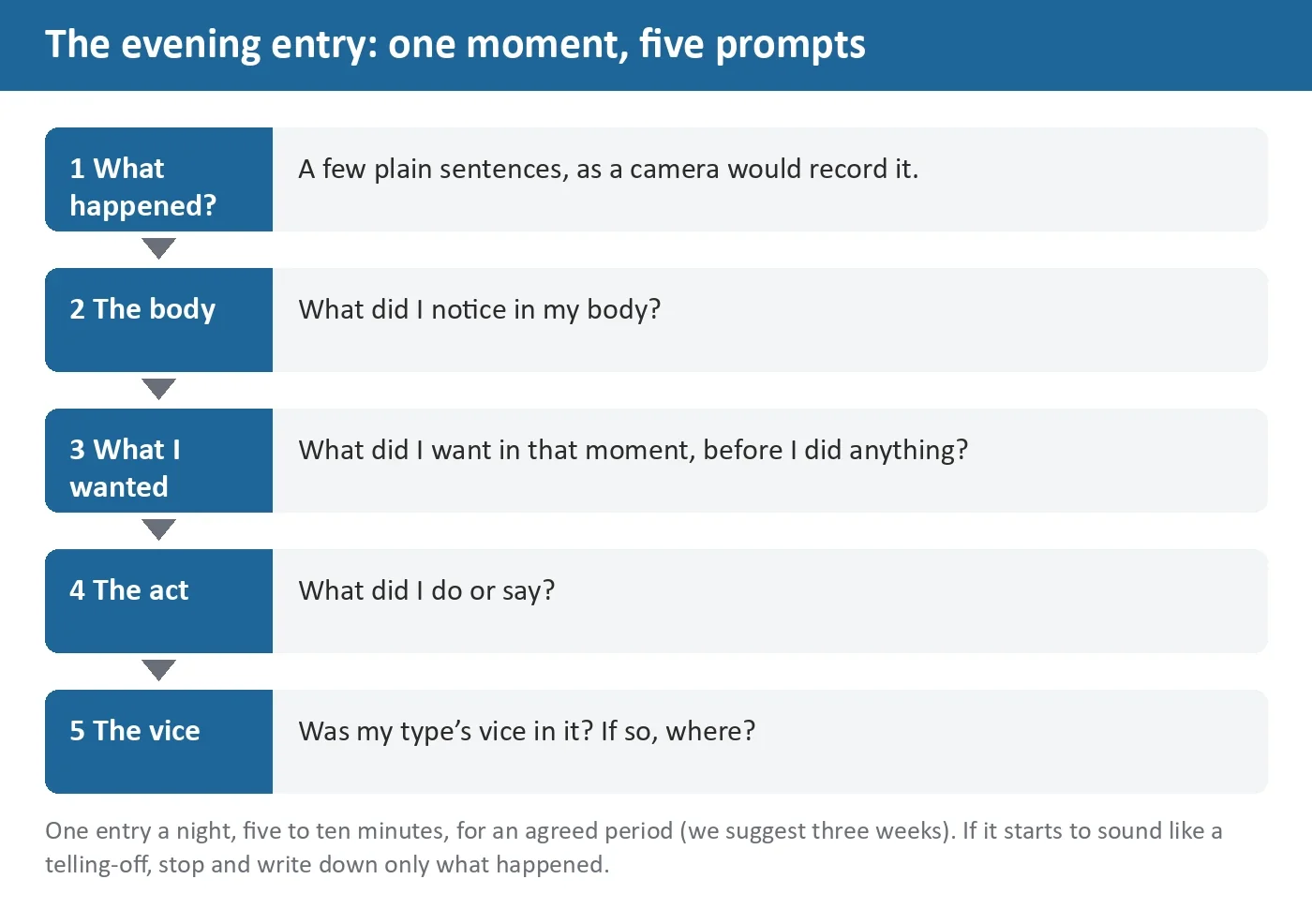
The entry. One a night, about one moment. Not a diary of the day, and not the week's worst moment saved for the weekend. Five to ten minutes, at roughly the same time, on paper or in a phone note. Five prompts:
- What happened? (A few plain sentences, as a camera would record it.)
- What did I notice in my body?
- What did I want in that moment, before I did anything?
- What did I do or say?
- Was my type's vice in it? If so, where?
Why these prompts. The second prompt brings the Action Center into the entry, and the third asks for the motivation before the behaviour. Many clients write fluently about what they thought and did, and have little to say about what their body was doing or what they wanted. Those gaps are worth noticing when you read the entries together, without making them a fault. The camera instruction is the client's first protection against writing a verdict instead of a description.
How long. Agree a fixed period; we suggest three weeks. An open-ended "from now on" tends to fade, and then becomes one more thing the client has failed at.
Who to hold back with. Before setting it, look at who is in front of you. In our practice, we hold back when the strain profile shows high psychological strain, when the client is in the middle of a bereavement or a crisis, or when the client has described a harsh inner critic in the debrief. None rules the practice out; each is a reason to start with one week and read the first entries together.
If entries later show distress beyond the scope of coaching, stop the practice and refer on, as described under "What this practice is not".
What is left out. Before the daily practice, Naranjo proposes an autobiography of childhood, tracing how character formed around painful early experiences. That is therapeutic work, and in a coaching contract we leave it alone.
Try this: the words to set it
At the end of your next appropriate session, set the practice in words like these:
"For the next three weeks, each evening, write a few lines about one moment from the day you would like to have lived differently. Not to fix it. Just to look at it with some curiosity. Bring the pages next time, and you decide which ones we read."
Give the client the five prompts above, on a card if you can.
Then add:
"If you miss a night, skip it. And if what you write starts to sound like a telling-off, stop and write down only what happened."
The client chooses what to share, which keeps the journal theirs. Naranjo, describing groups that share journal pages, recommends freedom to hold pages back, with an acknowledgement that something was held back. In a session that can be as simple as "There are two I am not reading", which needs no follow-up question.
A worked example: three weeks of entries
Week one: the camera points outward
Back to the composite client, a team lead who said in the debrief that they "always end up with the extra work". The first week's entries are mostly about other people. "My manager handed me the quarterly report at five o'clock." "A colleague asked me to cover the client call." The camera is pointed outward. This is normal. The useful question is small:
"Where were you in that moment? What was happening in you just before you answered?"
Week two: the entries turn round
"I said yes before the request was finished." "My shoulders went up, and I heard myself say it was no problem." The same move appears three times in five entries, twice at work and once on a family call. This is where the question we find most useful comes in:
"Is there a moment that keeps coming back in different clothes?"
The client answers, "They're all moments where I said yes too fast." That is a habit, and a coach could stop there. The third prompt (what did I want in that moment) is there to go underneath it:
"What did you want in that moment, before you said yes?"
The first answer is practical: "To get it off the table." The coach waits, then asks, "And just before that?" After a pause the client says, "For them not to be disappointed in me. I wanted to be the one they could count on."
The yes was the behaviour. The want was the vice the report described, now named from the inside. The coach's job is not to add to it: a coach who now explains what the vice is "really" about takes the discovery away from the client.
Week three: the verdicts start
In the third week the tone changes. "Said yes again. Pathetic." "Same thing. I never learn." The entries have become shorter and harsher, and the camera has gone. The client is now writing about a person, and that person is themselves. Looking back, there was a hint in the debrief: after laughing at the report, the client had said, "I should have seen this years ago." A coach listening for a harsh inner critic could have heard it there, and started with one week instead of three.
When the journal becomes the prosecution
For some clients, a daily record of moments they got wrong becomes evidence for the case against themselves. "I agreed before I had thought about it, and my jaw was tight" is a description of a moment. "I was pathetic again" is a verdict on a person.
Schreiber: curious interest. Russell Schreiber, who writes on self-study in the Gurdjieff tradition, names this risk. He notes that some people use what they learn through self-observation to justify more intolerance towards themselves, and he treats the urge to get rid of what we dislike in ourselves as a serious mistake. He attributes the tendency to the individual, not to a type. His remedy is a stance of curious interest, which he puts as a phrase to use on each discovery: "Oh, this is so interesting. I must find out more!"
Neff and Davidson: over-identification. Self-compassion writing gives the pattern a name. Kristin Neff and Oliver Davidson, summarising the field, describe a pattern Neff calls over-identification: being carried away by the story of one's own inadequacy until the story is taken for the self. Our own application is that the aim is not more cheerful entries. The coach watches the client's relationship to what they wrote.
What to do when the verdicts start
Neither Naranjo nor Schreiber offers a technique here, only a stance, and the coach has to hold it first. When the verdicts start, try asking the client to read the entry aloud, then:
"Read me that one again, and this time tell me only what a camera would have seen."
The composite client read "Said yes again. Pathetic." and then, more slowly: "My manager asked at ten past five. I said yes before the sentence ended. My jaw was tight on the drive home." Asked what was different between the two, the client said, "I can do something with the second one."
For the rest of the three weeks the coach dropped the fifth prompt (whether the type's vice was in it), so the entries held only what happened, the body, the want and the action. The verdicts thinned out, and two entries described a moment when the client paused before answering.
If the rewrite does not come, or the next week's entries are harsher still, shorten the practice or pause it. Pushing on feeds the pattern the practice was meant to show.
Watch your own wish for progress as well. A coach who is visibly pleased by a "breakthrough" entry can teach a client to perform for the journal. The published article Finding Compassion for the Types argues that compassion for oneself comes first.
Other ways it goes wrong
The client stops writing. Most clients miss nights; some stop in the second week. Ask about it with interest rather than as a lapse: "What was happening on the evenings you didn't write?" The answer is often about the vice too.
The client brings everything. Twenty-one entries cannot be read together in one session. Ask the client to choose two before you start:
"Pick the one that surprised you most and the one you least want to read. We'll start with the first, and read the second only if you want to."
The client analyses all day. Some clients carry the practice into every waking hour and feel watched by themselves. Remind the client that the day is for noticing and the evening for writing, and that the practice ends on a known date.
Variations for different settings
Clients who do not write. A voice note of a minute or two works, with the same five prompts.
Full lives. For a shift worker or a client caring for someone at home, a nightly entry may be one demand too many. Three entries a week, on agreed days, is enough.
Life transitions. In life coaching around a move, a separation or a career change, the transition can swamp every entry. Keep each entry on one ordinary interaction, where the vice is easier to see.
Groups and programmes. In a development group, sharing pages with freedom to hold back works, provided the group has agreed confidentiality and members read only their own words. The facilitator models the camera instruction (describe only what a camera would record) in the first round, because the first entry read aloud sets the tone.
Re-reading the report
Naranjo suggests that after three or four months of journal writing, a person re-read the section of the book on the inner dynamics of their type and write a statement of what their observations confirm and what they add.
Our coaching adaptation, credited to him, is shorter: at the end of the three weeks, the client re-reads their iEQ9 report and notes two things:
- What the journal confirmed.
- What it added that the report did not say.
The second list is often the more interesting. The composite client wrote: "It isn't only at work. And it happens fastest with people I like."
The report is a reference point, and the entries are the client's own evidence. Where the two disagree, that is worth a conversation, possibly about the type itself. Treat the journal as material for reflection, never as a measure of progress.
What this practice is not
The three-week period, the cautions about when to hold back, the camera instruction and the questions for reading entries together are our own application of Naranjo and Schreiber, not their method.
It is a coaching tool, not a treatment. If entries show distress beyond the scope of coaching, such as persistent hopelessness or any mention of self-harm, stop the practice, say plainly why, and refer on. The words can be simple:
"I'd like us to stop the evening pages for now. What you're writing sounds heavier than this exercise is meant to hold, and I think someone with different training could help you more than I can. Can we talk about who that might be?"
The ICF Code of Ethics asks coaches to recognise when a client would be better served by another professional; this is one place it becomes concrete.
An open question
Writing every evening about a moment you got wrong suits some clients well and is risky for others. Some practitioners screen for a harsh inner critic before setting it, while others set it and watch the first few entries closely. Which do you do, and what have you seen that made you change your approach?
Sources
- Claudio Naranjo, Character and Neurosis: An Integrative View (Gateways/IDHHB, 1994), ch. 10, "Suggestions for Further Work on Self".
- Russell Schreiber, Gurdjieff's Transformational Psychology: The Art of Compassionate Self-Study (Present Moment Press, 2013).
- Kristin Neff and Oliver Davidson, "Self-Compassion: Embracing Suffering with Kindness", in Itai Ivtzan and Tim Lomas (eds), Mindfulness in Positive Psychology: The Science of Meditation and Wellbeing (Routledge, 2016).