What is the Enneagram?
 Introduction to the 27 Subtypes
 Introduction to the 3 Centers
 Wings
 Lines and Integration
 Enneagram History & Origin
 Type 8 - The Active Controller
 Type 2 - The Considerate Helper
 Type 5 - The Quiet Specialist
 Type 9 - The Adaptive Peacemaker
 Type 3 - The Competitive Achiever
 Type 6 - The Loyal Sceptic
 Type 1 - The Strict Perfectionist
 Type 4 - The Intense Creative
 Type 7 - The Enthusiastic Visionary
 Enneagram for Myself
 Enneagram for Practitioners
 Enneagram for Business
 iEQ9 Individual Reports
 iEQ9 Team Reports
 iEQ9 Questionnaire
 Training Events
 Level 1 iEQ9 Accreditation
 Level 2 Enneagram Team Dynamics
 International Enneagram Conference
 iEQ9 Community of Practice Events
 About Integrative9
 Meet the Faculty
 Testimonials
 Contact Us

Parents often ask a practitioner to say what type their child is, and the answer has to be that we do not type children. This article offers a better response: an exercise that takes one word an adult uses about a child, such as "ungrateful" or "dramatic", and traces it back to the adult who says it, using the Learning Center's Lengthening the Pause technique (Pause, Challenge, Choose).
The problem: the question at the tea break
It comes at the break in a parent evening. Someone waits until the others have drifted towards the tea urn, then asks:
"I think I know what type my middle one is. Can I tell you what happens at home, and you tell me if I'm right?"
Our answer is familiar: the iEQ9 is for people aged 16 and older, used responsibly, and we do not type children. The answer is right, and it can still land as a closed door. The parent came with a real worry and leaves with a rule.
There is a better offer, and it starts with what the parent says next. Often the description that follows is not plain behaviour. It arrives already named: the child is "a quitter", "so dramatic", "never satisfied", "too sensitive for that school". The child has been labelled before being described, and the label carries the adult's way of seeing. That word is where the work can start.
The scenes in this article are composites and describe no particular family or school.
The exercise in brief
The exercise moves attention from the child to the adult who uses the word:
- Take one word you use about a child.
- Recall the last time you used it, and describe only what the child did.
- Pause. Go back to that moment: what were you thinking and feeling, and what did you do next? Mark the trigger for your type that the moment touched.
- Challenge. Ask whether the word gets you what you want for this child.
- Choose. Pick one small, different thing to say or do the next time that behaviour shows up.
An example: "All brain, no heart"
Mary Reckmeyer and Jennifer Robison, writing for Gallup in Strengths Based Parenting, tell the story of Elizabeth, a grandmother whose strongest gift is empathy. When the granddaughters were small, they played with dolls and watched old films together.
As they grew, their interests moved to the chess team, the maths club and the viola, and Elizabeth privately wondered whether the parents were raising the girls to be "all brain, no heart". A plan to buy vampire novels for Christmas was met with the reply that the girls would find them too sappy. Elizabeth was surprised, and a little hurt.
The authors use the story to argue that a child's talents may differ from an adult's, and that each of us judges behaviour through our own lens.
What interests us is the phrase. Nothing in the story suggests the girls lacked warmth. They had found things they loved. "All brain, no heart" describes the distance between their interests and Elizabeth's way of meeting the world, and then locates that distance in them.
What the word is doing
Janet Levine, in Know Your Parenting Personality, makes the same point from the parent's side. A parent who understands their own motivation may start to suspect that a child reacts the same way every time because the parent keeps coming at the child the same way. Levine's advice is largely for parents to get themselves out of the way.
The book's closing note on typing is blunter. Levine admits it is almost impossible, once you know this material, not to type the people closest to you, and then warns that we can be wrong, and that labelling others, especially our own children, can do real harm. The alternative, in Levine's words, is to "keep the spotlight of inquiry on ourselves".
The Integrative Enneagram model gives practitioners a way to do that. The Learning Center's Blind Spot, Trigger, Defense Mechanism loop (Module 7) runs like this:
- An event touches a blind spot and so becomes a trigger.
- The trigger brings the person into conflict with their idealised self-image and core motivation.
- Rather than question either, the defence mechanism takes over and reinforces the blind spot.
- The cycle repeats.
A label often appears at the moment the loop closes. The word sounds like an observation and moves attention off the adult and onto the child.
None of this makes anyone a worse parent or teacher. Every type has triggers. In our view, the further an adult moves along the Levels of Integration, the less the label is needed: the adult can stay with the behaviour a little longer before deciding what it means. Practitioners are not exempt.
What the research on teacher expectations does and does not say
The popular story, which began with Rosenthal and Jacobson's Pygmalion in the Classroom (1968), is that a teacher's expectations turn a child into whatever was expected. Lee Jussim and Kent Harber's 2005 review of 35 years of studies is more careful:
- The effects are usually small.
- They often fade.
- Teachers' expectations are often accurate.
That matters for how we run this exercise. We cannot tell a room of parents that one word at dinner will shape a child for life. The research does not support it, and frightened parents do not reflect well. We also cannot assume the word is wrong. A teacher who calls a pupil "disorganised" may be describing something real.
So the exercise claims less: accurate or not, the word shows something about the adult and shapes what the adult does next.
A worked example: one word, followed through
The word and the evening
A parent in one-to-one coaching about work mentions home almost in passing in the third session: the eldest, who is eleven, has become "so ungrateful". Asked what happened, the parent describes an evening. A meal had been planned and cooked with care after a long day. The eleven-year-old ate half of it, said it was fine, and left the table to message a friend. The parent cleared the plates without saying anything and was short with everyone for the rest of the evening.
Before going further, the coach named the shift: "We contracted on work. Do you want to spend some of today on this, or park it?" The parent chose to stay with it.
The parent's core type is the Considerate Helper. The Module 7 material lists being taken for granted among the Considerate Helper's triggers and offers a contemplative question for it: "Why is appreciation important to me?" It offers a second, sharper one: "What happens to me when I feel that I am not needed?"
Pause
The coach held both questions back and asked first what the child had actually done that evening, and the word got smaller. "Ungrateful" became "ate half, said it was fine, left the table". The coach then asked what the parent had been thinking and feeling as the plates were cleared. After a long silence, the parent said:
"I think I'd been waiting all day for someone to notice I'd done something for them."
"Ungrateful" answered the hurt by moving it across the table, so the parent never had to ask what the half-finished plate touched.
Challenge
The question ("Does this word get you what you want for this child?") brought a quick answer: an easy, warm relationship with an eleven-year-old starting to have a life elsewhere. The word, and the silence after it, was making the table a place to leave.
Choose
This step took two attempts. The first answer was "I'll stop taking it personally", which is a wish rather than a choice. The second was concrete: on a cooking night, say plainly beforehand, "I've made your favourite tonight, and I'd like us to sit together till we're both done", and on other nights let the meal be simpler.
A month later
The parent reported that the eleven-year-old still left the table early some nights. The difference was in the parent. "I notice the moment now," the parent said. "I don't always do anything different, but I notice it." Nothing may change at first. Noticing is where it starts, and it counts as progress.
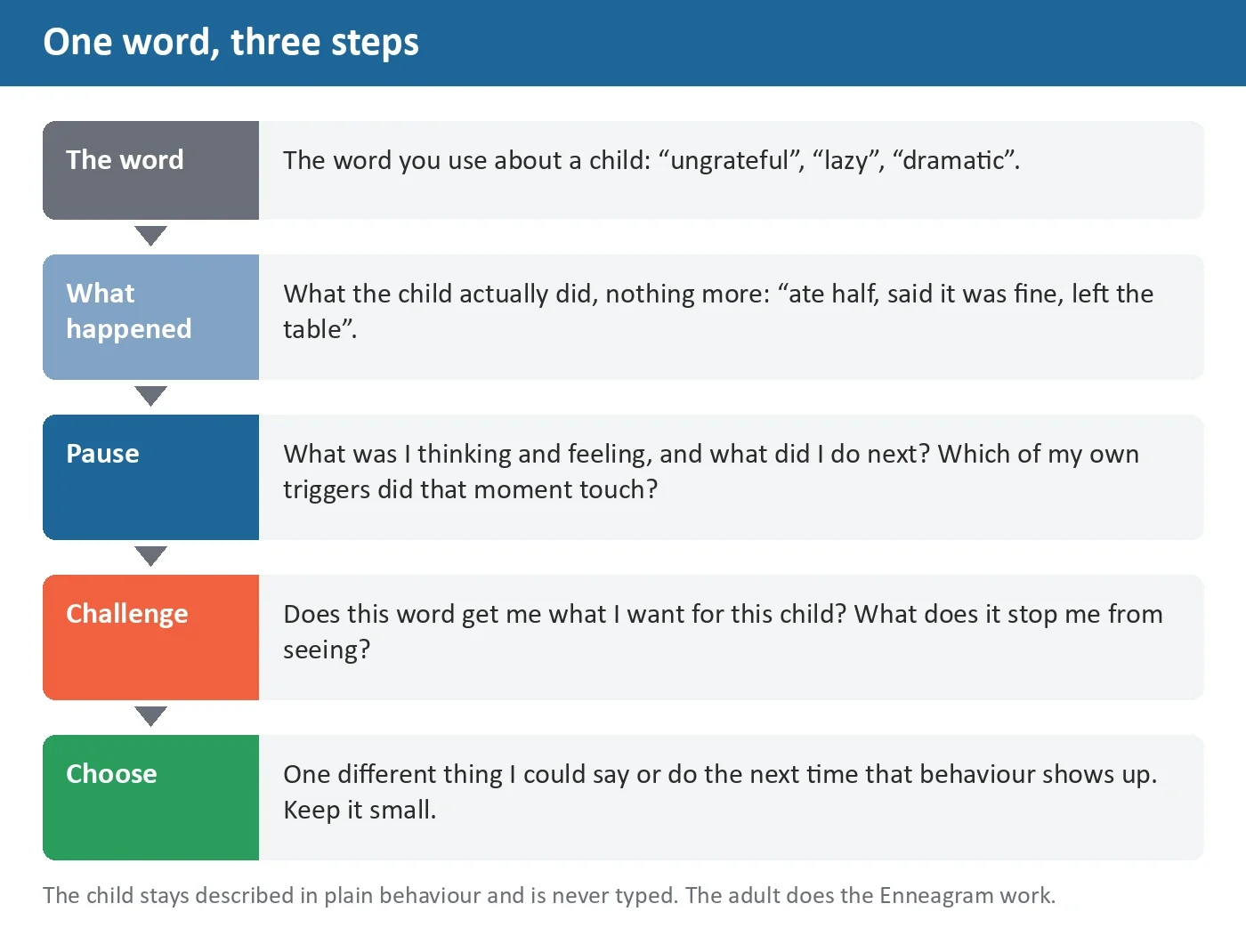
Try this: one word, three steps
Setting it up
- Reports. The full exercise needs each adult's own iEQ9 report, so say so in the invitation. If an open evening brings adults without one, they can still describe what the child did, then Challenge and Choose. They skip marking a trigger, and nobody guesses a type for them.
- Materials. The facilitator brings the list of triggers and contemplative questions for each core type from the Module 7 material, and, if it suits the group, the module's printable template.
- Timing. Allow about forty minutes in a workshop: ten to write, twenty in pairs, ten to share choices with the room.
Agree two ground rules at the start, in these words:
"Tonight the only types we talk about are our own. The children stay described by what they did, nothing more."
"No names, and nothing that would let someone here recognise the child."
The second matters because parents who share a school can often place each other's children.
The word
Open with:
"Write down one word you use about a child you care for or teach. Then write down the last time you used it, describing only what the child actually did."
"Lazy" becomes "was still in bed at ten on Saturday". "Dramatic" becomes "cried when the plan for the afternoon changed". The behaviour on the page is often smaller than the word.
Pause
"Go back to the moment you said that word. What were you thinking and feeling, and what did you do next? Now look at the triggers for your type and mark the one that moment touched."
If a participant marks nothing, offer the contemplative question for their core type. Do not choose the trigger for them.
Challenge
"Does this word get you what you want for this child? What does it stop you from seeing?"
Choose
"The next time that behaviour shows up, what is one different thing you could say or do?"
Keep the choice small. "Be more patient" will not last until Saturday morning. "Ask what time the light went off last night before I say anything else" might. In one-to-one work, the module suggests drawing on the client's Lines of Stretch and Release at this step.
When it goes wrong
The room starts typing the children
It will happen. Someone reads the trigger they marked and says, "Of course, that's because my youngest is obviously a…" Name it plainly and kindly, and bring the person back:
"That is a guess about the child. Let's leave the child with just what they did, and go back to the trigger you marked. What did that moment touch in you?"
Said aloud at home, a guess like that becomes one more repeated message to a young person who is still forming. Our article Nature, Nurture and Childhood Personality describes early neural pathways as "still very flexible and not fixed", and notes that children can distort even positive messages.
"But the word is true"
Someone will push back: the child really does leave every task half done. Agree that it may be so, because arguing would turn the session into a trial of the child. Ask instead:
"Suppose the word is completely accurate. What does saying it do to you, and to what you do next?"
Guilt arrives
Some parents move from "my child is" to "I did this". Nature, Nurture and Childhood Personality answers the question "did I do this to my child?" with "both yes and no". It explains that no parenting strategy prevents a child from developing a type, and that accepting children as the individuals they are is the stronger path. Say something close to that, then return to the next choice. The exercise is about the next Saturday morning, not the last ten years.
Something heavier surfaces
Sometimes the word sits on top of something heavier, such as the adult's own childhood or a child the school is already worried about. Nature, Nurture and Childhood Personality also recommends a therapeutic context for processing painful past experiences, and a child's safety is never a coaching matter. The practitioner's job then is to say so, follow the school's or organisation's safeguarding route, and refer.
Different rooms, different versions
One-to-one with a parent or teacher
Here the exercise can go slower. Use the client's Coaching Companion (the iEQ9 report the practitioner uses to prepare a debrief) alongside the Module 7 list, and come back to the chosen move in the next session. The useful question then is not "did it work?" but "did you notice the moment?"
Two adults, one child
When co-parents, or a parent and a class teacher, do the exercise together, a pattern often appears. The class teacher calls a child who cried at a timetable change "anxious". The parent calls the same tears "manipulative". Neither word is the behaviour, and side by side the two words show each adult's lens more clearly than either would alone. Each adult works from their own report, and the pair compares words, never verdicts on each other.
A staff workshop
In a school the words are often shared. Ask staff for a word they hear used about a pupil or a class, then ask who in the room has used it this term. Keep pupils anonymous: no names, no year groups small enough to identify anyone. Say at the start that this is about adults' habits, not a case conference. A genuine concern about a pupil goes to the school's own process, not the workshop.
What this exercise cannot do
It tells you nothing reliable about the child, and it does not show that the word was wrong. It works best when adults have their own reports and some willingness to look at them. A participant who came only to have a child explained may leave disappointed, and that is acceptable. What it offers is narrower: one adult, one word and one small different choice, which the adult may or may not make the next time.
An open question
In schools, the adult with the strongest lens is not always the person in the chair. A head teacher may call a whole year group "entitled", or a word for one pupil may have travelled round the staffroom until nobody remembers who said it first. When the word belongs to the most senior person in the building, or to no one in particular, how would you bring this exercise into the room?
Sources
- Janet Levine, Know Your Parenting Personality: How to Use the Enneagram to Become the Best Parent You Can Be (John Wiley & Sons, 2003).
- Mary Reckmeyer with Jennifer Robison, Strengths Based Parenting: Developing Your Children's Innate Talents (Gallup Press, 2016).
- Lee Jussim and Kent D. Harber, "Teacher Expectations and Self-Fulfilling Prophecies: Knowns and Unknowns, Resolved and Unresolved Controversies", Personality and Social Psychology Review 9(2), 2005, pp. 131-155.
- Robert Rosenthal and Lenore Jacobson, Pygmalion in the Classroom (Holt, Rinehart and Winston, 1968).
- Integrative Enneagram Solutions, Learning Center Module 7: The Blind Spot, Trigger, Defense Mechanism loop and Practitioner Technique: Lengthening the Pause.
- Dirk Cloete, Nature, Nurture and Childhood Personality (Integrative Enneagram Solutions, 2019).