What is the Enneagram?
 Introduction to the 27 Subtypes
 Introduction to the 3 Centers
 Wings
 Lines and Integration
 Enneagram History & Origin
 Type 8 - The Active Controller
 Type 2 - The Considerate Helper
 Type 5 - The Quiet Specialist
 Type 9 - The Adaptive Peacemaker
 Type 3 - The Competitive Achiever
 Type 6 - The Loyal Sceptic
 Type 1 - The Strict Perfectionist
 Type 4 - The Intense Creative
 Type 7 - The Enthusiastic Visionary
 Enneagram for Myself
 Enneagram for Practitioners
 Enneagram for Business
 iEQ9 Individual Reports
 iEQ9 Team Reports
 iEQ9 Questionnaire
 Training Events
 Level 1 iEQ9 Accreditation
 Level 2 Enneagram Team Dynamics
 International Enneagram Conference
 iEQ9 Community of Practice Events
 About Integrative9
 Meet the Faculty
 Testimonials
 Contact Us

Couples arrive at coaching ready to talk about how often they argue, and that matters. How long they stay apart afterwards is a question that, in our experience, most couples have never been asked. This article offers a coaching inquiry about the return: ask each partner, separately, when they felt the two of them were back after a disagreement and what brought them back, then look at the gap between their answers.
The problem: the quiet hour after a fight
Ask a couple about their last argument and you will hear about the loud part. Ask about the hour afterwards and the room often goes quiet. Each partner made their own tea. Someone asked whether the other wanted the light left on. The answers were polite and short. Nothing was shouted, yet the two of them were probably further apart in that hour than during the argument.
That polite quiet is ordinary. What differs, from couple to couple and fight to fight, is how long it lasts. We are not claiming it matters more than frequency, only that it gets left out. A coach who asks only about the fights tends to end up refereeing them. A coach who asks about the return is looking at something the couple can practise.
The inquiry in brief
In an early session, once you have agreed what the couple want from coaching:
- Before any joint work, ask each partner one question alone (see "Setting it up" below).
- Agree the couple's last three disagreements, by a one-line label only.
- Have each partner write privately when they felt the two of them were back, then put the answers side by side.
- Ask each partner what brought them back, and what they notice in the gap.
- Close by asking each partner for one small sign that, next time, the other is on the way back.
A worked example: two evenings, one fight
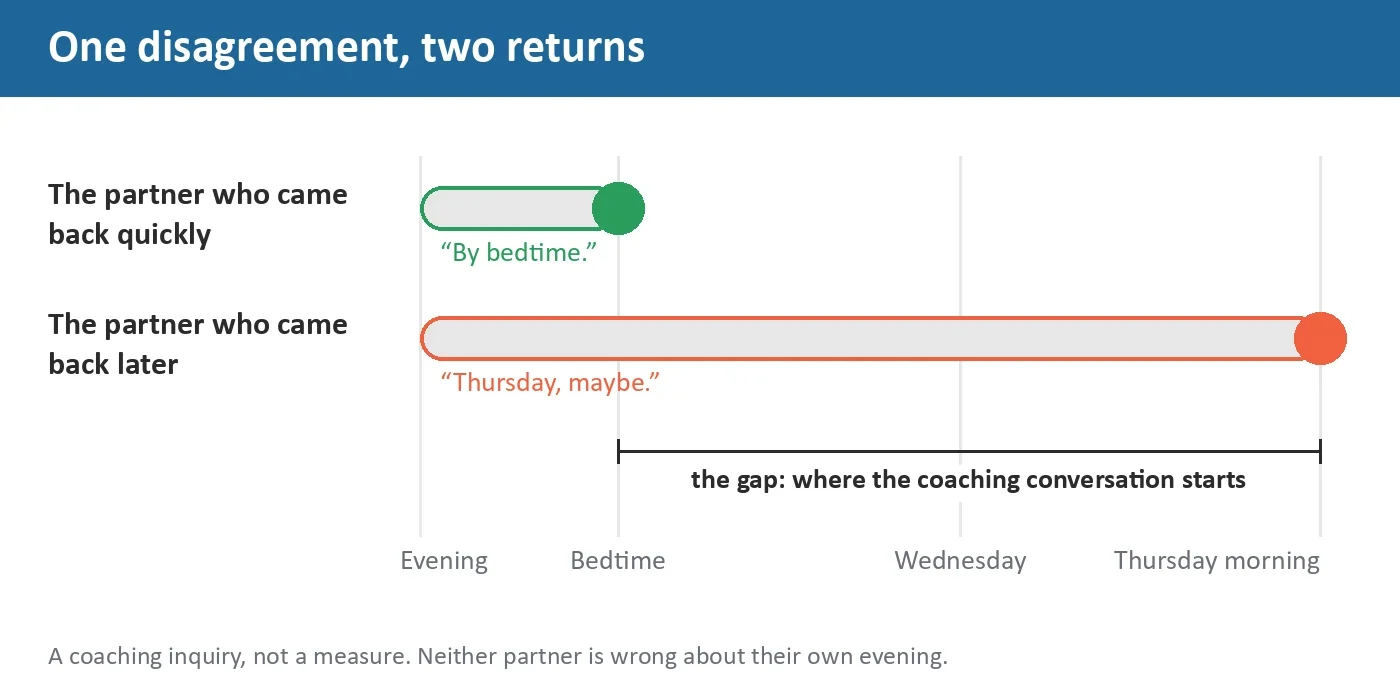
Here is a composite of several sessions, identifying no one. A couple come in after a disagreement about a family visit. The coach asks each partner, separately, when they felt the two of them were back. One partner says, without hesitation, "By bedtime. We were fine by bedtime." The other partner pauses and says, "Thursday, maybe. Thursday morning."
Neither is lying. The bedtime partner had an evening in which the argument ended, a joke landed over the washing-up, and things returned to normal.
The Thursday partner had an evening in which the argument went underground, the joke felt like a door being closed on the subject, and the next two days were spent waiting to see whether it would be raised again.
They are describing two different evenings that happened in the same house. For the bedtime partner, being back means the mood has lifted. For the Thursday partner, it seems to mean something closer to "the thing has been heard".
The gap is not a score, and it is not by itself a problem. Plenty of couples come back at different speeds and are content. It becomes a problem when nobody knows it is there. In the composite, the bedtime partner heard about Thursday for the first time in the session, and the first reaction was not defensiveness but surprise: "You never said."
What brought you back
The second half of the question asks how the return actually happened. John Gottman's research describes "bids": attempts one partner makes to connect with the other, which can be verbal or non-verbal. In one of his studies, of 130 newlyweds, as Suzann and James Pawelski report it in Happy Together, he found that couples still together six years later had turned towards each other's bids about 86 percent of the time, against about 33 percent for couples who later divorced.
That study looked at everyday life, not the hour after a fight. Carrying it over is our step. When clients answer "what brought you back", they usually describe a bid and what happened to it: a mug of tea put down without a word, a question about the other's day. Sometimes it was taken up. Sometimes it was missed.
In the composite, the joke over the washing-up was a bid from the bedtime partner. The Thursday partner noticed it and did not feel it as one. In our view, that tells a coach more than the content of the argument does.
Conflict Styles and the return
Our published article on the Enneagram and Conflict Styles covers what each style does during a disagreement. Here we stay with afterwards.
The Learning Center frames Conflict Styles as how people deal with not getting what they want, which is the territory of the hour after a fight. The table sets the Learning Center's description of each style beside our reading of how those descriptions can play out in the return.
| Conflict Style | Learning Center description | How it can look in the return (our reading) |
|---|---|---|
| Avoidant | Takes a positive outlook and moves on quickly. | A quick return to good humour can be a real reach towards the other partner, and can also look, from the other side, like the subject being dismissed. |
| Reactive | May need to vent first. | A partner who needs to say more can look as if they are refusing to come back, when the venting may be part of the way back. |
| Methodical | Puts feelings aside to deal with the problem. | A partner who has fixed the practical problem may believe the couple reconnected when the arrangements were sorted, while the other is still waiting for something warmer. |
None of this is a rule.
In the composite, the coach had the couple's iEQ9 Couples Report, which brings both partners' results together and has a chapter on managing conflict. The bedtime partner's dominant style was Avoidant, the Thursday partner's Reactive.
The coach deliberately left the styles, and that chapter, until after the inquiry. Raised first, the styles would have become the explanation ("that's just my style") before either partner had heard the other's evening. Raised afterwards, they made sense of what both had already seen.
The Learning Center's tip that, for the Avoidant Style, discomfort can be where learning happens then had a concrete form: staying a little longer in the unfinished quiet instead of ending it with a joke.
Your own style matters too, because it shapes what you hear as "back"; “Your Type Comes to the Debrief Too” (for accredited practitioners) looks at how a practitioner's type comes into the debrief.
Try this: the three-disagreements inquiry
Setting it up
Use this in an early session, once you have agreed what the couple want from coaching. Before it, ask each partner one question alone, in a short individual call booked as a routine part of starting couples work, so nobody is singled out:
"When the two of you disagree, is there ever a time you feel afraid of your partner, or of what might happen?"
If the answer is yes, or the answer leaves you uneasy, do not run the inquiry or any joint work on conflict. Do not raise what you heard with the other partner. Refer on to appropriate specialist support, and handle what you heard within the confidentiality you agreed at contracting, including its limits where someone may be at risk.
Then prepare the session:
- Allow half an hour.
- Give each partner a card with three rows, one per disagreement, to write when they felt back.
- Have a shared two-column page ready.
- On a video call, use a shared document and have each partner write on paper first.
Say what you are about to do:
"I'm going to ask you both the same few questions about your last three disagreements. You'll each write your answers on your own card first, without talking or looking. Then we'll put them side by side."
Agree the three disagreements together first, by a one-line label only ("the family visit", "the car", "Sunday"), so that nobody retells the fight. If a couple cannot name three, two is enough.
The questions
When were you back? Ask both partners at once, to write privately:
"For each of these three, when did you feel the two of you were back? Write an hour or a day if you can."
The private writing matters: a partner who answers after hearing the other tends to drift towards the first answer, and the gap shrinks before it reaches the page.
Compare the times. When both have finished, have them read their times out, one disagreement at a time, and write them up side by side.
What brought you back? Then, for each disagreement, ask each partner in turn while the other listens:
"What brought you back? What was the first thing that happened that told you it was over?"
Look at the gap together. Do not interpret the gap first. Ask:
"What do you notice when you see your answers next to each other?"
If the answers differ. A further question helps the partner who returned sooner:
"What would you have needed to see to know your partner was still away?"
And one for the partner who returned later, because noticing is often what fails first when someone is still hurt:
"Looking back, was there a moment your partner was reaching for you that you didn't count at the time?"
Close with one small sign. Ask each partner what one small sign would tell them, next time, that the other is on the way back. Write those down. They are often the most practical thing the couple take home.
When the inquiry goes wrong
The fight restarts
A common problem is that "when were you back?" pulls one partner straight into what the fight was about. Stop it early and kindly:
"I can hear that one still matters. Let's park what it was about for now. I'm only asking about afterwards: when did it feel over?"
If either partner is too stirred up to listen, pause, or return to the inquiry in a later session. Make the pause a real one. Guidance from the Gottman Institute, based on John Gottman's research on flooding, is that a partner whose body is in alarm, heart racing and unable to take in what is said, needs at least twenty minutes away from the subject before talking can help. That too tells you something about the return.
One partner corrects the other
When the partner who felt back by bedtime hears "Thursday", the reflex is often "That's not true, we were fine." Treat this as the gap appearing live in the room, not as an interruption:
"You're both telling the truth about your own evening. Let's keep both answers on the page."
"We're always fine straight away"
Some partners answer every row with "immediately". That may be accurate, or it may mean the other partner's waiting went unnoticed. Do not challenge it. Ask the follow-up questions as usual. If there is a gap, the other card will show it.
The answers match
When both partners give the same times, that is good news. Say so. "What brought you back" then becomes a conversation about what the couple already do well.
"We're never really back"
If one partner has not felt close for months, the inquiry has reached its edge. Name that plainly, without alarm, and without closing the session on it:
"What you're describing sounds bigger than how long it takes to come back after one disagreement. I don't want to treat it as a timing question when it may not be one. Could we talk about what kind of support would help with that, perhaps alongside what we're doing here, perhaps instead of it?"
Then talk through the options, including couples therapy, and agree a next step before the session ends. Leave time for it; a referral dropped into the final minutes is harder to hear.
The case, three months on
Back to the composite couple. The bedtime partner had meant the washing-up joke as an olive branch. The Thursday partner heard "we're not talking about this any more".
The coach did not ask either to change speed. Instead each named a sign. The Thursday partner asked for one sentence before the joke, something like "I know we didn't finish that." The bedtime partner asked to be told when the subject was still open, rather than guessing from the quiet.
Asked later about three new disagreements, the couple gave hours that had shortened a little, but that was not the main change. The Thursday partner now recognised the joke as a reach, even when it came early. The bedtime partner had started asking, "Are we done, or is there more?" And the gap could be talked about without starting the next argument.
Not everything moved. Twice the Thursday partner answered "Are we done?" with "Yes" out of habit, and only said on the Saturday that it had not been true. And the one disagreement that touched the family again took as long as the first: three days for the Thursday partner, one evening for the bedtime partner. Both partners came to see that subject as needing its own conversation. That is why, when we run the inquiry again, we compare the conversation rather than the hours.
Other settings
Working with one partner
Often only one partner is your client. Use one column, ask both questions, then ask for an estimate of the other answer:
"If your partner were sitting here, when do you think they would say you were back?"
The guess is not data about the partner. Say so. It is data about how the client reads the partner's return, and often the moment the client realises the question has never been asked at home. Be careful not to drift into coaching a relationship from one side, or into judging a partner who is not in the room.
A newer couple
There may be few disagreements to draw on, so ask forwards: "When you do disagree, what will tell you the other person is back?"
A workshop
Use the questions as a private written exercise each couple discusses together. Never ask couples to share answers with the room. An audience changes what two people will say.
What this cannot tell you
Treat this as a coaching inquiry, not a measure. It has not been validated, the times people give are memories coloured by the fight, and it predicts nothing about whether a relationship will last.
It is a conversation for two people who both want to come back. Where one partner is afraid of the other, it is not a reconnection conversation at all. A partner who is afraid is unlikely to say so with the other partner in the room, which is why the question in "Setting it up" is asked of each partner alone, before any joint session.
The strain profile also matters. A couple under high interpersonal strain may be showing you a hard season rather than their usual pattern. Our article Help! My Client Has Low Integration describes the Level of Integration as a bandwidth that narrows under High Strain, and suggests considering referral where a client is Low Integration and under extremely High Strain. For a couple, apply that to each partner, as a prompt for a conversation rather than a test.
And when you bring a case like this to colleagues, bring the practice question, not the people.
The question we are still holding
When the gap is clear, the obvious move is to help the faster partner slow down and the slower one come back sooner. We are not sure that is right. Some couples may do well with different speeds, provided each partner knows what the other's return looks like. For others, a wide gap, even understood, may leave one partner alone for too long. So we would like to hear from practitioners who work with couples: when two partners come back at very different speeds, do you work to close the gap, or to make it understood, and how do you decide which?
Sources
- Suzann Pileggi Pawelski and James O. Pawelski, Happy Together (TarcherPerigee, 2018), chapter 9, reporting John Gottman's research on bids and setting out the authors' Interaction Model.
- J. M. Gottman, J. Coan, S. Carrere and C. Swanson, "Predicting marital happiness and stability from newlywed interactions", Journal of Marriage and the Family 60(1), 1998, and John M. Gottman, The Relationship Cure (Three Rivers Press, 2001), both cited in Happy Together for the bids figures.
- The Gottman Institute, guidance on flooding and taking a break during conflict (gottman.com).
- Integrative Enneagram Solutions, Learning Center, "Exploring the nuances of Social and Conflict Styles".
- Integrative Enneagram Solutions, The Enneagram and Conflict Styles.
- Integrative Enneagram Solutions, Help! My Client Has Low Integration.