What is the Enneagram?
 Introduction to the 27 Subtypes
 Introduction to the 3 Centers
 Wings
 Lines and Integration
 Enneagram History & Origin
 Type 8 - The Active Controller
 Type 2 - The Considerate Helper
 Type 5 - The Quiet Specialist
 Type 9 - The Adaptive Peacemaker
 Type 3 - The Competitive Achiever
 Type 6 - The Loyal Sceptic
 Type 1 - The Strict Perfectionist
 Type 4 - The Intense Creative
 Type 7 - The Enthusiastic Visionary
 Enneagram for Myself
 Enneagram for Practitioners
 Enneagram for Business
 iEQ9 Individual Reports
 iEQ9 Team Reports
 iEQ9 Questionnaire
 Training Events
 Level 1 iEQ9 Accreditation
 Level 2 Enneagram Team Dynamics
 International Enneagram Conference
 iEQ9 Community of Practice Events
 About Integrative9
 Meet the Faculty
 Testimonials
 Contact Us

Retirement ends the role that carried a client's core motivation for decades, but not the motivation itself, which keeps running with nowhere obvious to point. This article offers a coaching approach that first lets the loss be a loss and then helps the client tell the role from the need.
The problem: "I don't know what I'm for"
Picture a client who retired five weeks ago (a composite of several conversations, not one person). For eleven years the client ran a regional operation of a few hundred people, until a restructure brought an early retirement offer. The client took it, partly by choice and partly because staying on looked worse. The pension is sound, the health good and the diary blank in the way they spent thirty years wishing for. Twenty minutes into the first session, they say something they have clearly not said at home:
"I've got everything I said I wanted, and I don't know what I'm for."
Most retirement advice treats the problem as lost structure: fill the days, keep busy. Some clients need exactly that. But this client has plenty to do. What they lack is a place for the drive that has run their whole working life. There is a loss in the sentence too, not yet called one.
The tool in brief
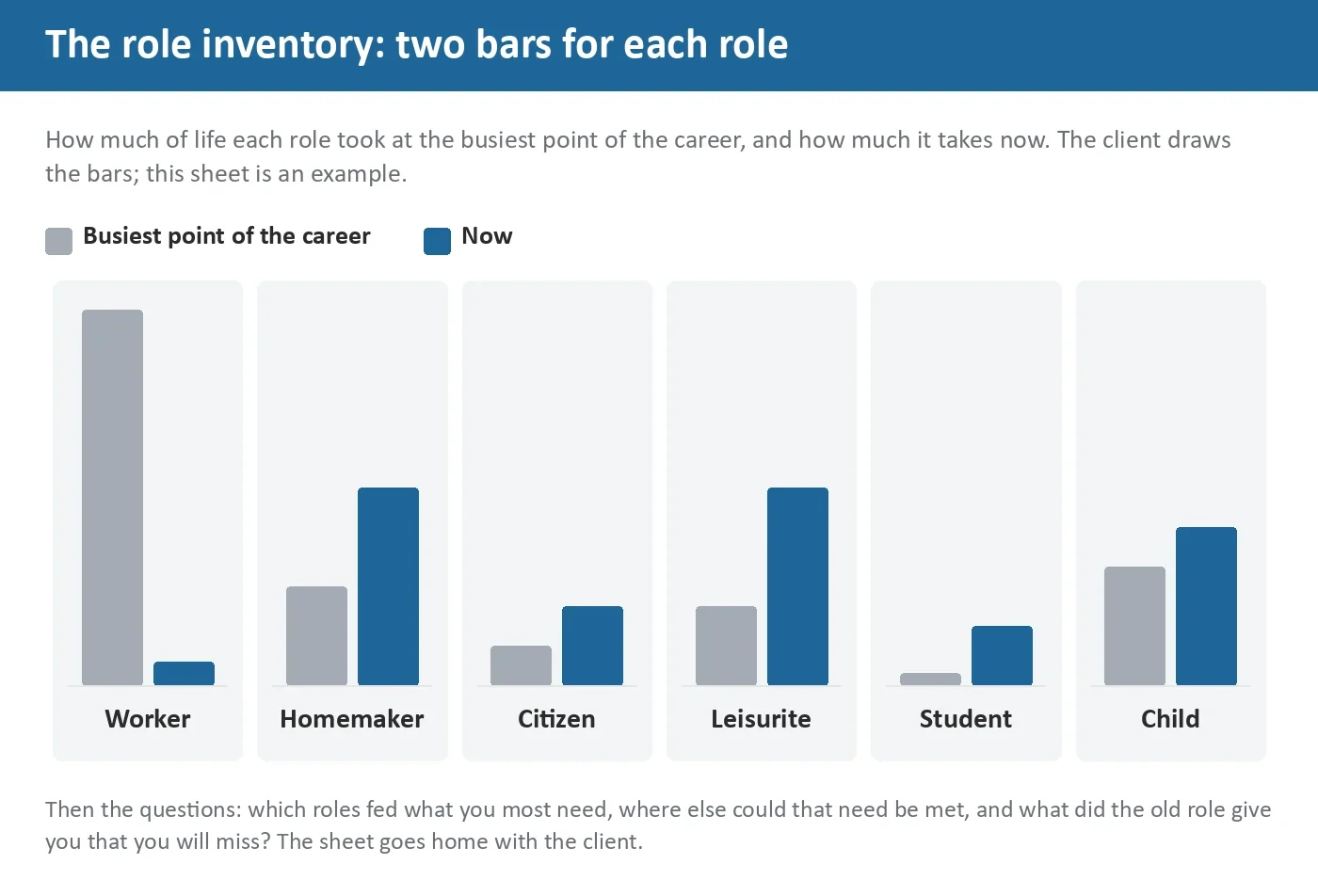
After the iEQ9 debrief, the client draws six life roles (worker, homemaker, citizen, leisurite, student and child) as they were at the busiest point of the career and as they are now, then answers four questions:
- Which of these roles do you hold now, and which did you hold at the busiest point of your career?
- Which of them fed what you most need, and which only paid the bills or filled the time?
- Where else could that need be met, starting now?
- For a role that fed the need but cannot continue: are you looking to get the role back, or the need?
The aim throughout is to help the client tell the role from the need, after the loss has had room.
The role and the motivation
For decades a career is usually the main vehicle for a person's core motivation. The job is where a Strict Perfectionist got to put things right every day, or where a Considerate Helper was needed before the first coffee. When the job ends, the role retires. The motivation does not. It keeps running, and for the first time in years it has nowhere obvious to point.
This is the Integrative Enneagram position that core type stays stable while its expression develops (see Can you change your personality?), applied to one life event.
It also changes the coach's first question: from "what can I still do?", which transferable skills answer, to "what was all that doing for me?"
Let the loss be a loss
First, the loss needs room. A working life ends with a lunch and a card, but what has gone may be daily competence and being known by people who saw the work. Mindy Greenstein and Jimmie Holland, in Lighter as We Go, write of the courage it takes to "climb back down this career ladder" and to face who one is without a professional identity.
For our composite client the loss had a sharper edge: the restructure said the organisation could manage without them. For someone whose worth rested on being the one who made the region work, that landed harder than the end of the job. In the first session the client mentioned it once, briskly, and moved on to plans. The coach noticed the speed and let it pass.
Type is one lens here, not the whole explanation. How the retirement came about, money, health, a partner's own transition and ageing parents all shape what the client brings, and a coach who reaches for type first will sound glib.
When the loss surfaces, name it in the client's terms, not the organisation's, then stop talking:
"It sounds as if the hardest thing to lose was being the one whose results everyone could see."
No reassurance, and no plan in the same breath.
Hold the boundary too. Grief at the end of a career is ordinary and coachable. Persistent low mood, withdrawal or hopelessness is a reason to suggest a doctor or counsellor. The ICF Code of Ethics expects a coach to explore whether another professional would serve the client better, and our Learning Center notes that extremely high psychological strain may call for therapeutic support in addition to or instead of coaching.
What the identity research adds
Greenstein and Holland describe two ways we respond when an experience challenges our self-image:
- Identity assimilation. We look for evidence that fits the self-image we already hold and play down the change.
- Identity accommodation. We revise our idea of who we are and what we can do, which can be felt as sad loss of competence or as growth in another area.
A core identity remains under both. Assimilation is not a failure. The point is balance, and the authors note that not every new experience leads us to change how we define ourselves. A client who says "I'm still someone who builds things" is not necessarily in denial.
No single pattern of adjustment. Mo Wang's study of retirees (2007) found most showed little change in well-being, while others dipped after retiring and then recovered. Hanna van Solinge and Kène Henkens (2008) found that adjustment problems were linked to a lack of control over the decision to retire. For our composite client, five weeks in, that suggests a dip would not be unusual and need not last. It also suggests that the restructure deserves weight: an offer taken partly by choice was also partly not.
Continuity as wisdom. A story from Greenstein and Holland's chapter headed "the wisdom of continuity in the face of change" makes a related point. A physicist, made to retire at seventy, went straight on to organise a graduate programme at a local college, yet named the chief loss as the intellectual exchange with colleagues. The physicist kept seeking out peers, including a group that lunches together regularly.
Sometimes, Greenstein and Holland suggest, wanting one's context to change as little as possible when change is forced is itself a form of wisdom.
Notice what the lunches rebuild: what the job supplied, not the job.
One type, two ways through the same loss
In the second session, working through the iEQ9 report, the client recognised themselves as a Competitive Achiever whose image and job title had grown together.
The Integrative Enneagram model names the Type 3 vice as Deceit, which the Learning Center describes as crafting and presenting only what the person wants others to see, and hiding weakness or vulnerability. It frames vices as habits that let us function only in a limited, dissatisfied way. It frames the move towards the virtue, for Type 3 Veracity, as "some of the most intense and deep work" we can do. Deceit does not retire with the client.
At lower integration. As we read it, Deceit can turn retirement into a performance: a full diary shown off to friends, or a consultancy set up mainly to keep a title on a business card. The grief of leaving is never admitted, least of all the message the restructure sent.
At higher integration. The client can often say plainly that they miss being seen to succeed, and then ask a better question: once the applause is gone, what did I actually value in that work? Helping a client tell the role from the need is often the most useful early move in retirement coaching.
Try this: a role inventory in four questions
This is our adaptation of Donald Super's six life roles, as Gysbers and colleagues set them out: worker, homemaker, citizen, leisurite, student and child. People revisit them at transitions, hold several at once, and find the roles wax and wane across a life. In later life "child" means being the adult child of ageing parents; time with the client's own children and grandchildren goes under homemaker.
Set-up
Use it after the iEQ9 debrief, once the core motivation has been named in the client's own words. Allow most of a session.
- Draw six columns on a large sheet, one per role, and give the client the pen.
- Ask for two bars in each column: how much of their life the role took at the busiest point of the career, and how much it takes now.
- The coach writes nothing. The sheet goes home with the client.
The four questions
Question 1: which roles, then and now.
"Which of these roles do you hold now, and which did you hold at the busiest point of your career?"
Let the drawing answer this one.
Question 2: what fed the need.
"Which of them fed what you most need, and which only paid the bills or filled the time?"
Link the answers to the core motivation, not to tasks or skills. Often it was one part of the worker role. Our composite client said the budget rounds were the price, and the moment a struggling team turned a year around was the point.
Question 3: where else the need can be met.
"Where else could that need be met, starting now?"
Ask for one or two new vehicles and one small step for each, with a date.
Question 4: the role or the need.
"What did that role give you that you are going to miss? Are you looking to get the role back, or to get [the client's own word for the need] back?"
This is for a role that fed the motivation but cannot continue, such as the job itself or a team that has moved on. Fill the bracket with the client's words from the second question ("seeing a team turn it round"), not a type label. Ask it slowly, and expect the first answer to be the role.
When the inventory goes wrong
The client lists tasks, not needs. "I liked the board meetings." Ask "And what did that give you?", then ask it again of the answer. Two or three rounds usually reach the motivation.
The client jumps to solutions. Slow it down: "Hold that idea. Before we test it, what is it meant to give you?" A plan that cannot answer is often the old role in a new suit.
The loss arrives in the room. The fourth question (the role or the need) can bring tears or a long silence. Stop the exercise. The sheet will keep. Name what you heard as the need, not the job:
"It sounds as if what you miss most is [the need, in the client's words]."
Then let the rest of the session be about what came up.
The client doubts the type. Run the inventory without it. Ask the second question (what fed the need) as "What did you most need from it?" and let the client's own words carry the motivation.
"None of it fed me. It paid the bills." Believe it, then look at the other columns. For some clients the motivation always lived in the citizen or leisurite role, and retirement is the first time it can have the whole day.
The child column is heavy. Caring for an ageing parent may be filling the new time. Do not expect it to carry what the job carried.
Variations for different settings
A year or more before retirement. The inventory does most good here: a new vehicle can start at low stakes while the worker column shrinks.
Forced retirement, ill health or redundancy. Spend longer on the loss, and leave the inventory until the client is ready. The first task may be keeping what continuity can be kept.
Pre-retirement programmes in organisations. Participants complete the sheet privately and share only what they choose, ideally in pairs. Agree in advance with the sponsor that no individual sheet or report goes back to the employer. A workshop can open the second question; the fourth belongs in individual work.
Phased retirement or a return to work. A part-time version of the old job can carry the motivation, or only its outward shape. The fourth question sorts one from the other.
The worked example, three months on
Third session: the inventory
Our composite client did the inventory. The worker column was nearly full at the peak and almost empty now. The second question stalled: the client listed meetings and reports, then crossed them out, until only the year a struggling team turned around was left. The child column was a surprise. An ageing parent was taking more of the week than the client had noticed.
Fourth session: the consultancy
The client brought a consultancy half set up: a company name and website, and a former deputy promising introductions. The coach did not argue, and asked one question:
"If nobody ever knew you were doing this, would you still want to do it?"
The client laughed, then took a long time to answer. The work with struggling teams, yes. The website and the title, no.
Then, unprompted, the client went back to the restructure: the website was for former colleagues who had stayed on, and for a board that had decided the region could do without its head. The client was angry, then quiet, and said it had felt like being written off.
The coach left the consultancy and the type alone, said back what had been lost in the client's own terms, and left room. Most of the session went on it.
The following weeks
The consultancy shrank to two small engagements with teams in trouble, and the client began mentoring through a local enterprise programme where there was no title at all. The drive still wanted to see something succeed and be part of the success. The client could now say so and choose where it went.
It would be easy to tell this as the vice defeated. It was not that tidy. The client kept the company name and mentioned the engagements a little more often than needed, and the anger about the restructure came back in later sessions, smaller each time. The real change was a client who could feel the pull of the image and choose otherwise some of the time.
What this approach cannot do
The distinction between role and motivation is a lens, and it has edges:
- It can make a practical problem sound psychological. Money or health may need taking seriously first.
- It can turn rest into a problem to solve. Some clients do not want a new vehicle for anything, at least for a while, and a coach who keeps looking for one may be serving their own motivation rather than the client's.
None of the research we have drawn on was written about the Enneagram. Linking the identity research or Super's roles to core motivation is our reading, offered as a way of working, not as a finding.
When the coach is retiring too
Many of the coaches reading this are approaching these years themselves. A coach who has not asked which part of their own practice feeds their type may hear a client's loss through their own. That coach may then rush the client towards a plan, or linger in a grief that is the coach's. Doing the inventory on yourself first helps; “Your Type Comes to the Debrief Too” (for accredited practitioners) looks at how the practitioner's type enters the debrief.
An open question
The hardest call in this work is the consultancy, the board seat, the part-time return. Sometimes it is the vice keeping the old role alive; sometimes it is a sensible bridge that buys the motivation time to find a new home, or the continuity the identity research calls wise. How do you tell the two apart with a client, and when do you say what you see?
Sources
- Mo Wang, "Profiling retirees in the retirement transition and adjustment process", Journal of Applied Psychology 92(2), 2007, pp. 455–474.
- Hanna van Solinge and Kène Henkens, "Adjustment to and satisfaction with retirement: Two of a kind?", Psychology and Aging 23(2), 2008, pp. 422–434.
- Mindy Greenstein and Jimmie Holland, Lighter as We Go: Virtues, Character Strengths, and Aging (Oxford University Press, 2014).
- Norman C. Gysbers, Mary J. Heppner and Joseph A. Johnston, Career Counseling: Holism, Diversity, and Strengths (American Counseling Association, 2014).
- Integrative Enneagram Solutions, Learning Center, Module 15: Delivering deeper developmental opportunities for clients using Type Vices and Virtues.
- Integrative Enneagram Solutions, Learning Center, Module 12: Good Stress versus Bad Stress.
- International Coaching Federation, ICF Code of Ethics (effective 1 April 2025).