What is the Enneagram?
 Introduction to the 27 Subtypes
 Introduction to the 3 Centers
 Wings
 Lines and Integration
 Enneagram History & Origin
 Type 8 - The Active Controller
 Type 2 - The Considerate Helper
 Type 5 - The Quiet Specialist
 Type 9 - The Adaptive Peacemaker
 Type 3 - The Competitive Achiever
 Type 6 - The Loyal Sceptic
 Type 1 - The Strict Perfectionist
 Type 4 - The Intense Creative
 Type 7 - The Enthusiastic Visionary
 Enneagram for Myself
 Enneagram for Practitioners
 Enneagram for Business
 iEQ9 Individual Reports
 iEQ9 Team Reports
 iEQ9 Questionnaire
 Training Events
 Level 1 iEQ9 Accreditation
 Level 2 Enneagram Team Dynamics
 International Enneagram Conference
 iEQ9 Community of Practice Events
 About Integrative9
 Meet the Faculty
 Testimonials
 Contact Us
Film clips are a popular way to bring the Enneagram to life in a workshop. But the question that usually follows a clip, "So, what type is this?", teaches people to read type from behaviour, which is the habit the Enneagram asks them to unlearn. This article offers an alternative: pause the clip just before a character makes a key choice, ask the group to predict the choice, and then ask what the character would have to believe for it to make sense.
The problem: when the loudest guess wins
The clip ends, the lights come up, and the facilitator asks: "So, what type is this?" Within a minute someone has said "Eight, obviously, look at the temper", and someone else has said "Six". The most confident voice usually settles it. People leave having practised the very habit the rest of the workshop tries to unteach: reading type from behaviour.
That is no reason to drop film. Nobody has to defend their own type while discussing a stranger's, and everyone sees the same evidence at the same moment. What needs to change is when we stop the clip, and what we ask.
The technique in brief
Instead of playing a scene to the end and asking for a type:
- Pause the clip in the second before the character makes a decision.
- Ask for a prediction: "What is the character going to do next?"
- Ask the question that matters: "What would the character need to believe for that to feel like the only thing to do?"
- Play the rest, and test the group's beliefs against what actually happens.
The first question draws the group in. The second moves attention from what the character does (behaviour) to why (motivation), and motivation is what Enneagram type is about.
A worked example: Salieri in Amadeus
The scene
Our example is one scene from Amadeus, the 1984 film of Peter Shaffer's play. Throughout, "Salieri" means the character Shaffer wrote, not the historical composer. Nothing here describes the real Salieri or Mozart.
We describe the scene as the philosopher Joseph Kupfer presents it in Virtue and Vice in Popular Film. Watch it yourself before you use it: Amadeus, the "absolute beauty" scene (YouTube). Clips of this scene online usually stop before Salieri drops the pages, so you may need the full film for the ending.
Background. Earlier in the film, Mozart plays Salieri's welcome march back from memory and improves it on the spot. Kupfer reads this moment as exposing limits in Salieri's talent that years of applause had hidden.
The manuscript scene. Later, Mozart's wife, Constanze, secretly brings Mozart's drafts to Salieri, hoping for a recommendation for a royal teaching post. As Salieri reads, the soundtrack plays the music on the page. Kupfer notes Salieri's amazement that there are no corrections, because the music was already complete before it was written down. Kupfer describes Salieri's face as caught between ecstasy and despair. Salieri then drops the pages, walks out, and resolves to work against Mozart, and against the God who gave such gifts to someone so undeserving.
Where to pause. While Salieri is still reading, before the pages drop.
Won't people already know what happens? Amadeus is famous, so some of the room will know what Salieri does next, which would normally rule a clip out. It still works here, because knowing what Salieri does doesn't tell you what Salieri had to believe to do it, and that is the question the exercise is built on.
Two published readings of Salieri
Two authors have written about this character. Their views give you useful material, to offer the group as ideas to test, not answers to hand over.
Jeff Lyons: Salieri as a Four. The screenwriter Jeff Lyons uses the Enneagram to build characters (Rapid Story Development) and reads Salieri as a Four whose deepest fear is being ordinary: secure in a sense of specialness at first, then thrown into panic when Mozart's genius makes that specialness look thin. Underneath sits a conviction: musical talent and success are God's reward for piety. In Integrative Enneagram terms, the reading fits the Four's vice of Envy, which the Learning Center describes as the sense that fulfilment is always just out of reach while others reach it easily. It is still Lyons's reading, for the group to test rather than receive.
Joseph Kupfer: three additions. Kupfer does not write about the Enneagram, but the reading of this scene adds three points:
- Envy sits beside admiration. Salieri hears exactly how good the music is. Kupfer argues that a lack of humility stops admiration from being enough. A group that sees only spite has missed half the scene.
- Envy looks for a justification. Kupfer argues that envy is shameful enough that it almost demands a story to make it feel warranted. Salieri's story is about Mozart's character: vulgar and boastful, set against Salieri's own restraint and devotion. Kupfer offers two explanations. Perhaps the sense of moral superiority is an excuse for plain wanting. Or perhaps it is the real cause, and a worthier Mozart would have been admired, even befriended. Kupfer does not think the film settles this, so the second question (what Salieri had to believe) has two defensible answers on screen.
- The narrator may not be reliable. The film is framed as Salieri's confession to a young priest, and Kupfer suggests that Mozart's flaws are likely exaggerated in the telling. There is a parallel in our work: an iEQ9 profile also rests on a person's account of themselves. In a debrief, it is fair to keep in mind how far to trust the narrator. This is not suspicion of the client. It is a reminder that every self-description is given from inside the pattern it describes.
Try this: running the exercise
Before the session
- Watch the whole film, not only the scene.
- Note your times: the start point (shortly before Constanze arrives) and the pause point. Hunting for them live costs you the tension you need.
- For a group new to the film, play the march scene first, then the manuscript scene.
- Allow about 45 minutes (a rough plan, not a tested rule): 10 for the clips, 20 to 25 for the discussion after the pages drop, and the rest for Lyons's reading.
- With more than about 15 people, take predictions at small tables first and have each table report one belief.
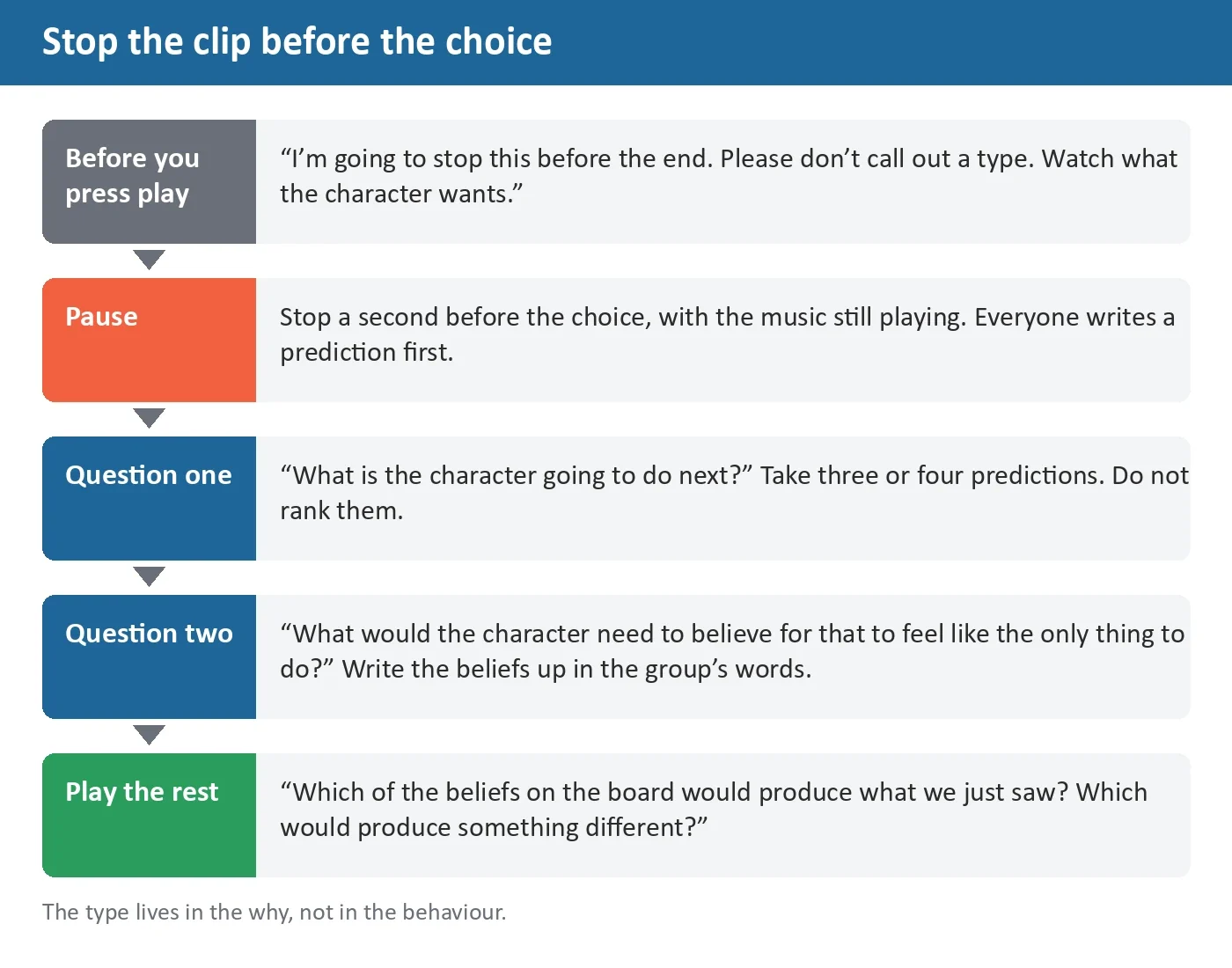
Before you press play, tell the group only this much:
"I'm going to stop this before the end. Please don't call out a type. Watch what the character wants."
At the pause
Stop the clip while the music is still playing. Ask everyone to write down a prediction before anyone speaks (online, have them post it in the chat on your signal). Then ask the first question:
"Before we see the rest: what is Salieri going to do next?"
Take three or four predictions. Do not rank them. Then ask the second question, the one that matters:
"What would Salieri need to believe for that to feel like the only thing to do?"
Write the beliefs on the board in the group's own words. Then play the rest. When the pages hit the floor, ask:
"Which of the beliefs on the board would produce what we just saw? Which would produce something different?"
What the board might look like
This is an illustration, not a record of a real session. Suppose three beliefs go up, worded as a group might word them but drawn from the sources:
| Belief on the board | Where it comes from | What it explains |
|---|---|---|
| "Talent is God's reward for a devout life." | Lyons | The vow. If the gift was payment for devotion, Mozart's genius is a broken bargain, and the anger has a target beyond Mozart: God. |
| "If I am not exceptional, I am nothing." | Lyons's Four reading | The despair and the dropped pages. On its own, though, it could just as easily lead Salieri to give up composing as to declare war on God. |
| "A worthier Mozart would have earned my admiration." | Kupfer (moral superiority as the real cause) | Contempt for Mozart the man. On our reading it fits this scene least: Mozart is not in the room. Salieri is alone with the music, and the music is what breaks Salieri. |
Side by side, the beliefs become ideas the scene can test, and a group may notice that the vow needs more than one of them.
Putting the published reading on trial
Only after that discussion, introduce Lyons's reading:
"Lyons reads Salieri as a Four. What in this scene supports that, and what would point you somewhere else?"
We have not yet tested this with groups, but we expect the first answers to the second question to name a feeling ("Salieri is jealous"), and asking "And underneath the jealousy?" to move people toward motivation. If a group argues for a different type, let it run; only asking why can settle it.
When the exercise stalls
Someone knows the film, or every prediction is right. With a well-known film this is likely. Thank whoever announces the plot, then ask: "We all saw it coming. What did we read in the face that told us?" Then ask for at least two different beliefs that would produce the same act.
A type gets named anyway. Write it in a corner of the board without comment and come back to it after the clip. If you argue with it at the pause, the group starts defending a type instead of exploring a belief.
Answers stay on the surface. "Jealous", "angry", "hurt". Ask once more, in the same words each time: "And underneath that?" If the room is still stuck, offer Kupfer's two explanations as a choice: "Is the contempt for Mozart the reason, or the excuse?" In our experience, people who would not volunteer a belief will often pick a side. If even that does not move the room, write a sentence stem on the board and ask people to finish it: "Salieri believes that a gift like this should..."
One voice fills the room. If it still happens despite the written predictions, read out two of the paper answers yourself before taking more from the floor.
The scene lands too close. Envy is a vice most people keep private, as Kupfer notes, and a participant may start talking about a sibling or a rival. Acknowledge it briefly and bring the conversation back to Salieri. If something more than recognition seems to be surfacing, a private word afterwards is kinder than a public follow-up.
Other formats
A TV series. The same character can face the same choice across several episodes. Pause before a later return to that choice and add: "We've seen this character choose this twice. What would have to change for the answer to be different?"
A novel. Read a passage aloud and stop before the decision, or hand out the text with the final paragraph removed. The page often shows a character's thinking, which makes the second question easier and the question of how far to trust the narrator richer.
One-to-one sessions. Some clients like to bring a scene of their own: a character they find themselves defending, or one they cannot stand. Asking "What would that character have to believe to do that?" about a stranger can be a gentler first step than asking the client the same question directly.
From the workshop into the debrief
The Learning Center's practitioner technique, Lengthening the Pause, asks clients to notice the space between a trigger and their habitual reaction, in three moves: pause; challenge whether the usual response gets them what they want; and choose. What follows is our own application of the clip exercise to that technique, not something the technique prescribes.
Choose where to stop. When a client recounts a reaction they regret, let the story run once, then go back and stop just before the act:
"Let's go back to just before you replied. Stay there a moment."
Ask the second question. It carries over almost word for word:
"In the second before you reacted, what were you believing about yourself?"
Go underneath the feeling. Clients often answer with a feeling: "I was angry." Take it as accurate and ask the same follow-up: "And underneath that?" A belief usually arrives as a sentence about how things are or should be, such as "If I don't push back now, I'll be overlooked again." If the answer stays a feeling, do not press a third time. Offering two possibilities, as Kupfer's two explanations did for the group, lets the client choose rather than confess.
With clients whose type is Four. The Learning Center's question about Envy sits close to Kupfer's point about justification: "What is the story I create when I feel I could be missing out?" Salieri's story about Mozart's character is one version of that story.
Levels of Integration. The Learning Center describes them as reflecting how far a person's blind spots are still "blind". As an analogy only (a clip measures nobody's integration, and a fictional character has no iEQ9 profile), the scene shows that the same core motivation could have produced a generous choice instead.
And if your own type pulls you toward one reading of Salieri before the group has spoken, notice that too.
What a single scene cannot do
Kupfer argues that you cannot know whether someone is patient or courageous from a thin slice of behaviour, only from how they act over time and across circumstances. Kupfer makes this point about moral character; applying it to type is our step. One scene is a thin slice, and a facilitator who ends with "So Salieri is a Four" has undone the exercise. A clip shows what is visible. Type is defined by motivation, the least visible part.
A film character is also written to be read. Shaffer built Salieri so that an audience would understand the envy; a real client rarely arrives so clearly shaped. Genre can also give the prediction away: drama viewers know that a long close-up often comes before something terrible. That is pattern-matching on storytelling, which is why the second question carries the weight.
Choosing a clip that will hold
- One character, one choice. The scene should turn on a decision the audience can see coming but cannot be sure of.
- Pressure without caricature. If the character is a cartoon of a type, the exercise collapses into the stereotypes our article Myth-busting the Enneagram Types warns about.
- A choice that is not in the trailer. If half the room already knows what happens, the first question is answered from memory; only the second still does its work.
- Room for more than one answer. Mixed feelings on screen, like Salieri's ecstasy and despair, give the second question something to work with.
- Licensing. Showing a commercial film, even a short clip, to a paying group may need a public performance licence, depending on your country and venue. Check what applies where you work. This is a prompt to check, not legal advice.
An open question
Lyons's reading of Salieri is well argued, and naming it early can close a debate before the group has done the work. Naming it late can feel like a reveal, as if there were a right answer all along. Some would rather never name it. When you use a character whose type a published author has already assigned, at what point, if any, do you tell the group, and what changes when you do?
Sources
- Joseph H. Kupfer, Virtue and Vice in Popular Film (Routledge, 2021), Introduction and Chapter 4, "Amadeus as a portrait of envy".
- Jeff Lyons, Rapid Story Development: How to Use the Enneagram-Story Connection to Become a Master Storyteller (Routledge, 2020), Chapter 10, "The Moral Component", and Chapter 11, "The Moral Enneagram".
- Integrative Enneagram Solutions, Learning Center Module 7: "Practitioner Technique: Lengthening the Pause" and "The Blind Spot, Trigger, Defense Mechanism loop".
- Integrative Enneagram Solutions, Learning Center Module 14: "Demystify Levels of Integration".
- Integrative Enneagram Solutions, Learning Center Module 15: "Delivering deeper developmental opportunities for clients using Type Vices and Virtues".
- Amadeus, directed by Miloš Forman, screenplay by Peter Shaffer (Orion Pictures, 1984).